Volume, Order Flow, and Value
Price shows what happened. Volume, order flow, and value help explain how much participation supported the move, where the market accepted price, and where reactions may become more likely.
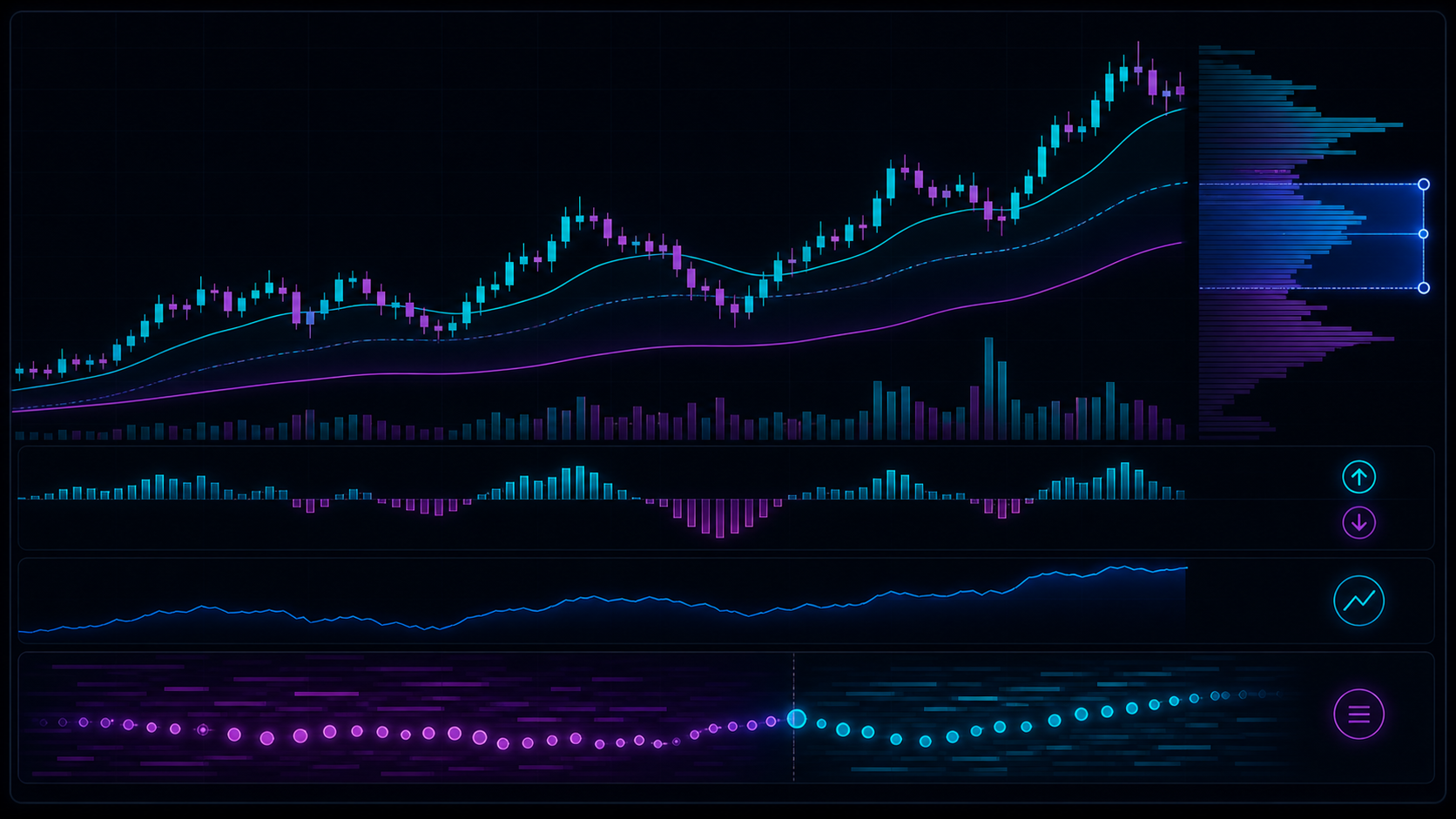
Read this section after learning trend, momentum, and market context. These tools are powerful, but they work best when you already know whether the market is trending, ranging, compressing, or expanding.
Participation and Pressure
- Trading Volume Explained
- What Is Volume Delta?
- Cumulative Volume Delta Explained
- Buying and Selling Pressure Explained
- Absorption and Exhaustion Explained
Positioning and Confirmation
- What Is Open Interest?
- Price and Open Interest: Four Core Scenarios
- How Price, Volume, Delta, and Open Interest Work Together
Value and Structure
- VWAP Explained
- Anchored VWAP Explained
- Volume Profile, POC, VAH, and VAL
- Fair Value Gaps Explained
- Order Blocks Explained
What You Should Be Able to Do Afterwards
- distinguish normal volume from meaningful participation;
- understand what delta and cumulative delta can and cannot show;
- read open interest as positioning context, not an entry signal;
- combine price, volume, delta, and open interest without overfitting;
- use VWAP and anchored VWAP as value references;
- understand POC, VAH, VAL, fair value gaps, and order blocks as areas of interest;
- separate confirmation from prediction.
Practice With ZenAlgo
Use Delta and Heavy Delta for participation context, Advanced Open Interest for positioning, Five Elements for multi-factor confirmation, and Swing Volume Profile or Control for value-area mapping.
Continue with Divergences and Confluence to learn how disagreement becomes useful only when it fits a complete setup. Then practice confirming trades with order flow without turning every volume spike into an entry.
Order-flow and value tools describe market behavior, but they do not remove uncertainty. Data can be estimated, delayed, incomplete, or different across venues.