Divergences and Confluence
Divergence is a warning that price and internal evidence are no longer moving together. Confluence is the discipline of combining several independent reasons before risking money.
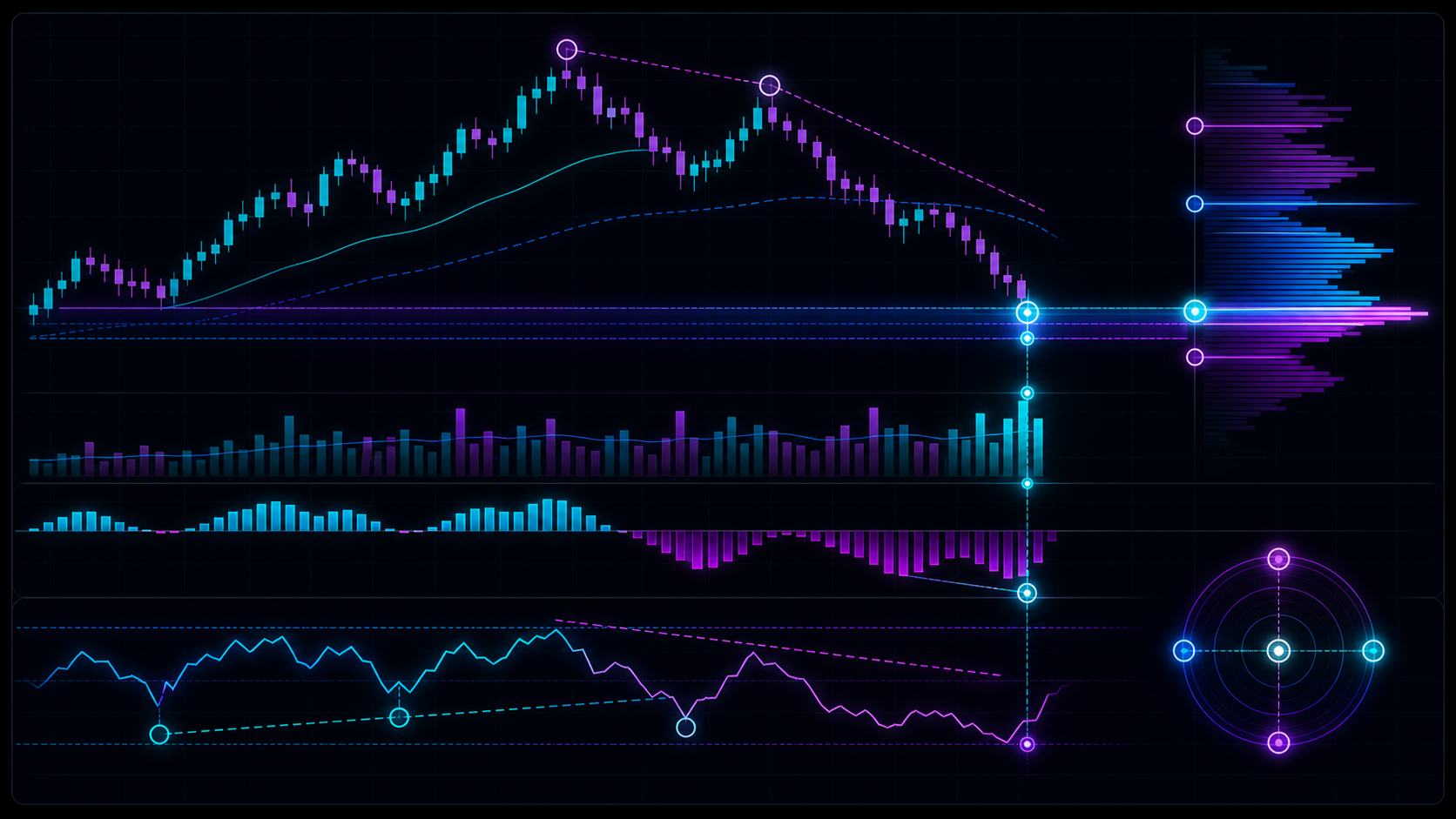
Read this section after volume, order flow, and value. Divergence becomes much easier to understand when you already know what momentum, delta, value, and market context are trying to tell you.
Divergence Foundations
- What Is a Trading Divergence?
- Regular Bullish and Bearish Divergence
- Hidden Bullish and Bearish Divergence
- Price and Delta Divergence
- Why Divergences Fail
- How to Confirm a Divergence
Confluence and Setup Quality
- Confluence in Trading
- What Makes a High-Probability Trading Setup?
- Signal vs Setup: What Is the Difference?
- How Many Indicators Should You Use?
What You Should Be Able to Do Afterwards
- define divergence without treating it as a guaranteed reversal;
- distinguish regular divergence from hidden divergence;
- understand why delta divergence is different from oscillator divergence;
- filter divergence with trend, location, volume, and confirmation;
- build confluence from independent evidence instead of redundant indicators;
- separate a signal from a complete setup;
- keep a chart useful without turning it into noise.
Practice With ZenAlgo
Use Waves and Advanced RSI for oscillator divergence, Q for free momentum divergence context, Delta and Ultimate for participation disagreement, and Five Elements or Engine for broader confluence.
Continue with Building a Trading Strategy to turn signals and confluence into rules you can actually follow and review. When you test those rules, use rule adherence metrics so a lucky signal does not get mistaken for a complete setup.
Divergence and confluence improve decision quality, but they do not predict outcomes. Any setup can fail, even when several conditions align.