What Is a Trading Divergence?
A trading divergence happens when price moves in one direction while an indicator or internal market reading moves differently.
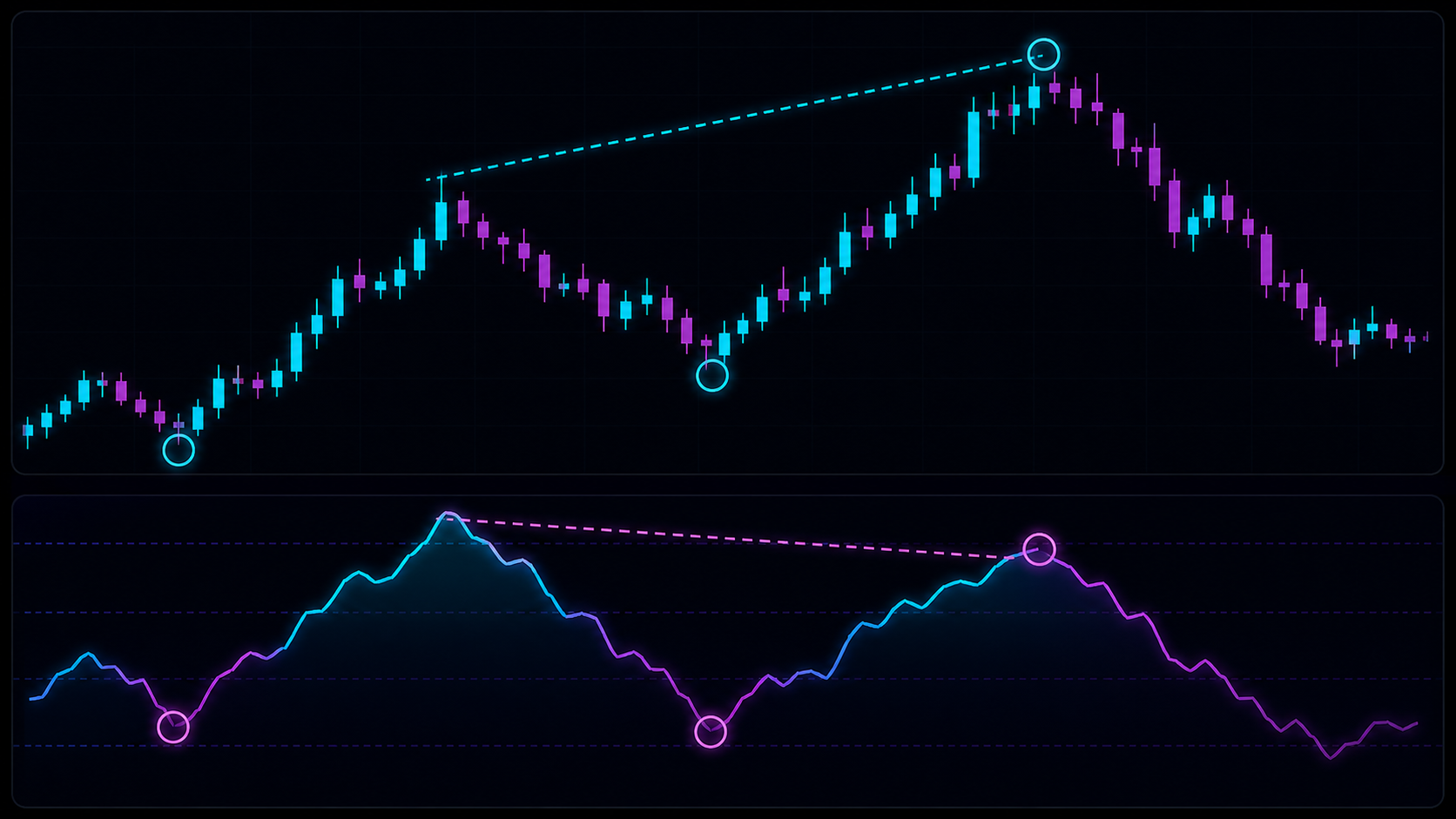
Divergence is disagreement. It does not say that price must reverse immediately; it says the current move deserves closer inspection.
The Core Idea
Price is the final result on the chart. Momentum, delta, volume, or other indicators describe what may be happening underneath that result.
When price and the supporting evidence agree, the move is easier to trust. When they disagree, the move may be weakening, pausing, or changing character.
A Simple Example
Imagine price makes a higher high, but an oscillator makes a lower high.
Price says:
The market pushed higher.
The oscillator says:
The push was weaker than the previous one.
That disagreement is a bearish divergence. It warns that upside momentum may be fading.
Divergence Is Not a Trade by Itself
This is the part that saves traders a lot of frustration.
A divergence is not an entry. It is not a stop. It is not a target.
It is a reason to ask better questions:
- Where is price relative to trend?
- Is this happening at support, resistance, VWAP, or value?
- Is volume confirming the warning?
- Does price structure actually shift?
- Is the market trending too strongly to fade?
Common Types
| Type | Main use |
|---|---|
| Regular divergence | Warns about possible exhaustion or reversal |
| Hidden divergence | Supports possible trend continuation |
| Delta divergence | Shows price disagreeing with buying/selling pressure |
| Multi-indicator divergence | Shows several tools warning together |
Using ZenAlgo
Waves marks regular and hidden divergences on Wave and MoneyFlow. Advanced RSI marks RSI divergences, and Q offers free momentum divergence context.
For order-flow disagreement, use Delta or Ultimate.
Continue Learning
- Study regular bullish and bearish divergence.
- Learn hidden divergence.
- Review momentum.
Divergence can appear early, repeat several times, or fail completely. Never enter only because an indicator disagrees with price.