How Many Indicators Should You Use?
The right number of indicators is the smallest number that helps you make consistent decisions.
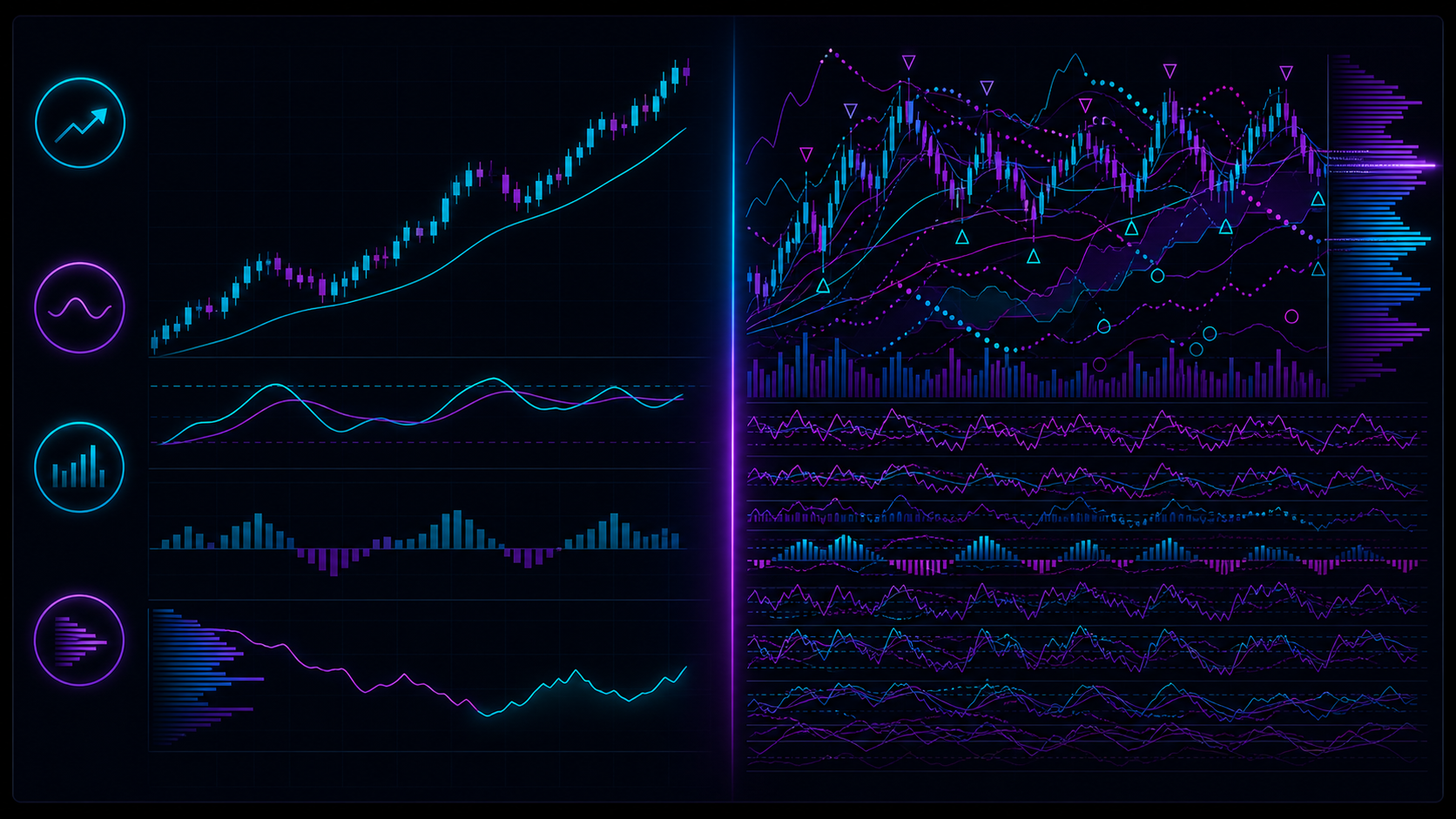
Use indicators by role, not by quantity. One tool for trend, one for momentum, one for volume or order flow, and one for value is usually more useful than five tools doing the same thing.
The Problem With Too Many Indicators
Too many indicators create:
- conflicting signals;
- slower decisions;
- confirmation bias;
- chart clutter;
- strategy hopping;
- false confidence.
More information is not always more clarity.
Think in Roles
A clean chart can cover several roles:
| Role | What it answers |
|---|---|
| Trend | Which direction has control? |
| Momentum | Is strength increasing or fading? |
| Order flow | Does participation confirm price? |
| Value | Is price stretched or near fair value? |
| Execution | Where is entry, invalidation, and target? |
You rarely need multiple tools for the same role unless each adds something genuinely different.
A Practical Starter Stack
For many traders, a simple stack might be:
- one trend/context tool;
- one momentum or divergence tool;
- one volume/order-flow tool;
- one value or levels tool;
- a risk and execution plan.
The plan matters more than the number of indicators.
Using ZenAlgo Without Clutter
ZenAlgo systems are designed to combine related tools so you do not have to build a messy chart from scratch.
Examples:
- Avenger for trend and value;
- Waves or Q for momentum and divergence;
- Delta or Ultimate for participation;
- Five Elements or Engine for broader confluence.
Keep or Remove?
For each indicator, ask:
- What decision does this improve?
- Is another indicator already doing the same job?
- Do I know exactly how I use it?
- Does it reduce mistakes or add hesitation?
- Would my strategy still work without it?
- Does it fit my timeframe?
Continue Learning
- Study confluence.
- Review setting up TradingView with a clean workflow in mind.
- Explore Five Elements.
Removing indicators does not automatically improve trading. The goal is a simpler decision process, not fewer tools for the sake of fewer tools.