Signal vs Setup: What Is the Difference?
A signal is one event. A setup is the full trading idea around that event.
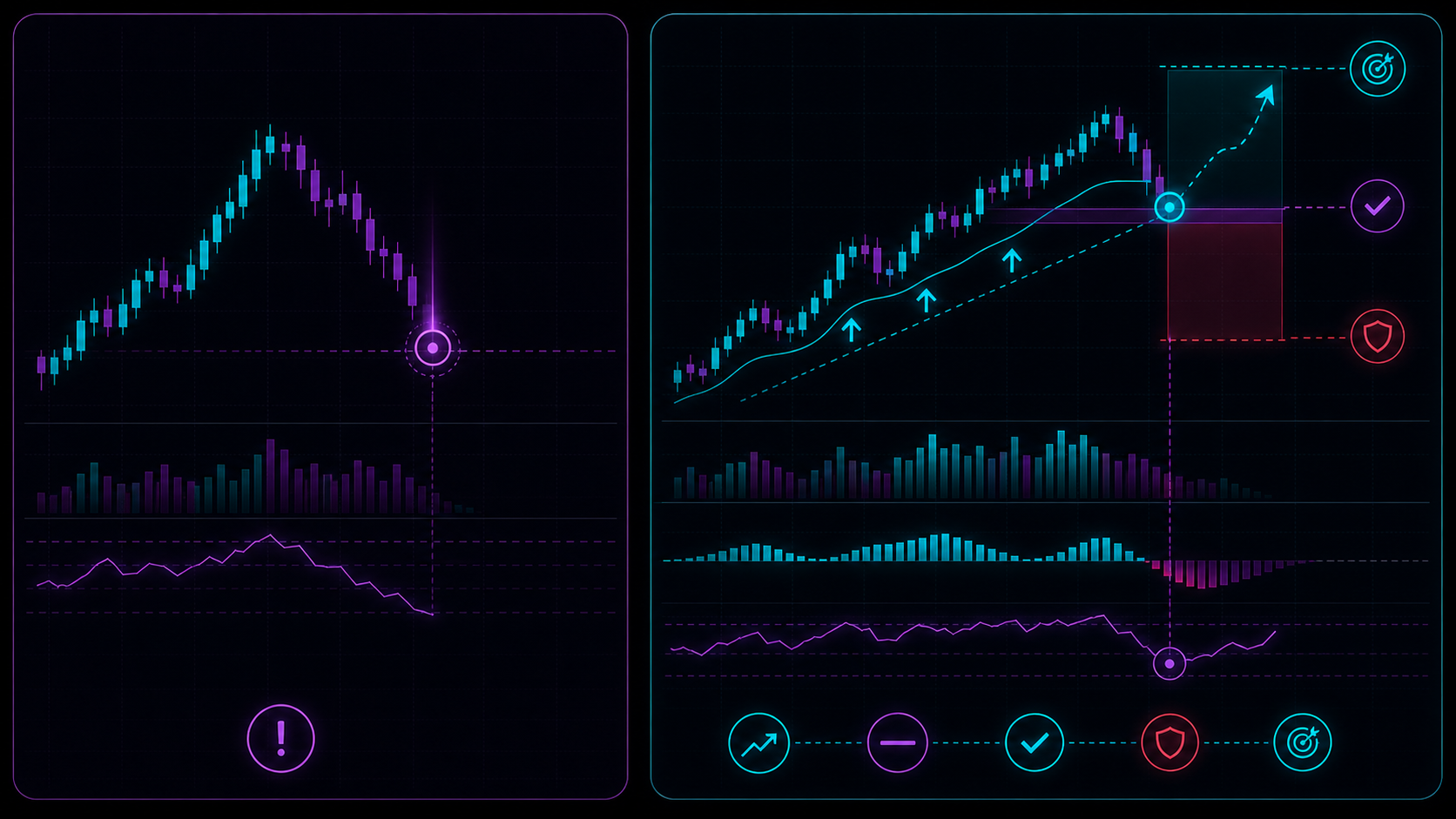
A signal says "look here." A setup says why the trade is valid, where it is wrong, how risk is sized, and what outcome makes sense.
Signals are attractive because they are simple. A divergence appears. A candle breaks a level. An indicator changes color. The chart seems to say, "Pay attention."
That attention is useful. The mistake is treating attention as permission.
A signal is a prompt to investigate. It is not a complete trading plan. If a trader enters every signal, the account becomes a collection of reactions instead of a strategy.
What a Signal Can Do
A signal can highlight momentum change, participation disagreement, a breakout attempt, a VWAP reclaim, a delta flip, or an alert from an indicator. It can help you notice something faster than you would have noticed it manually.
That is valuable. But it does not answer the most important questions: Is the market condition appropriate? Is the location good? Where is invalidation? Is the reward worth the risk? Does this trade belong in the strategy?
Those questions belong to the setup.
What a Setup Adds
A setup includes context, location, trigger, confirmation, invalidation, position size, target logic, and management rules.
For example, a bullish divergence near support in a range may be part of a mean-reversion setup. The same divergence during a strong downtrend, far from value and directly under resistance, may be only a warning that momentum is slowing. It might not be a trade.
The signal is the same. The setup quality is different.
Using ZenAlgo
ZenAlgo indicators can produce signals, context, and readiness information. Waves may show a divergence, Delta may show participation disagreement, and Avenger may show whether price is extended or aligned with trend.
Engine helps group ideas into continuation, pullback, or contrary families, which is useful for keeping signals attached to a setup type.
The practical rule is simple: know what job each tool has before the signal appears.
A Simple Test
When a signal appears, ask: "What setup type does this belong to?"
If you cannot answer, observe instead of entering. If you can answer, continue: does context support that setup, is location good enough, what confirms entry, where is invalidation, and what is the planned risk?
This connects naturally to high-probability setups, position sizing, and rule adherence metrics.
Continue Learning
- Learn high-probability setups.
- Study how many indicators to use.
- Review position sizing.
Signals can create urgency. Urgency is not edge. A skipped low-quality signal is often good trading.