Position Sizing Explained
Position sizing converts a trade idea into controlled account risk.
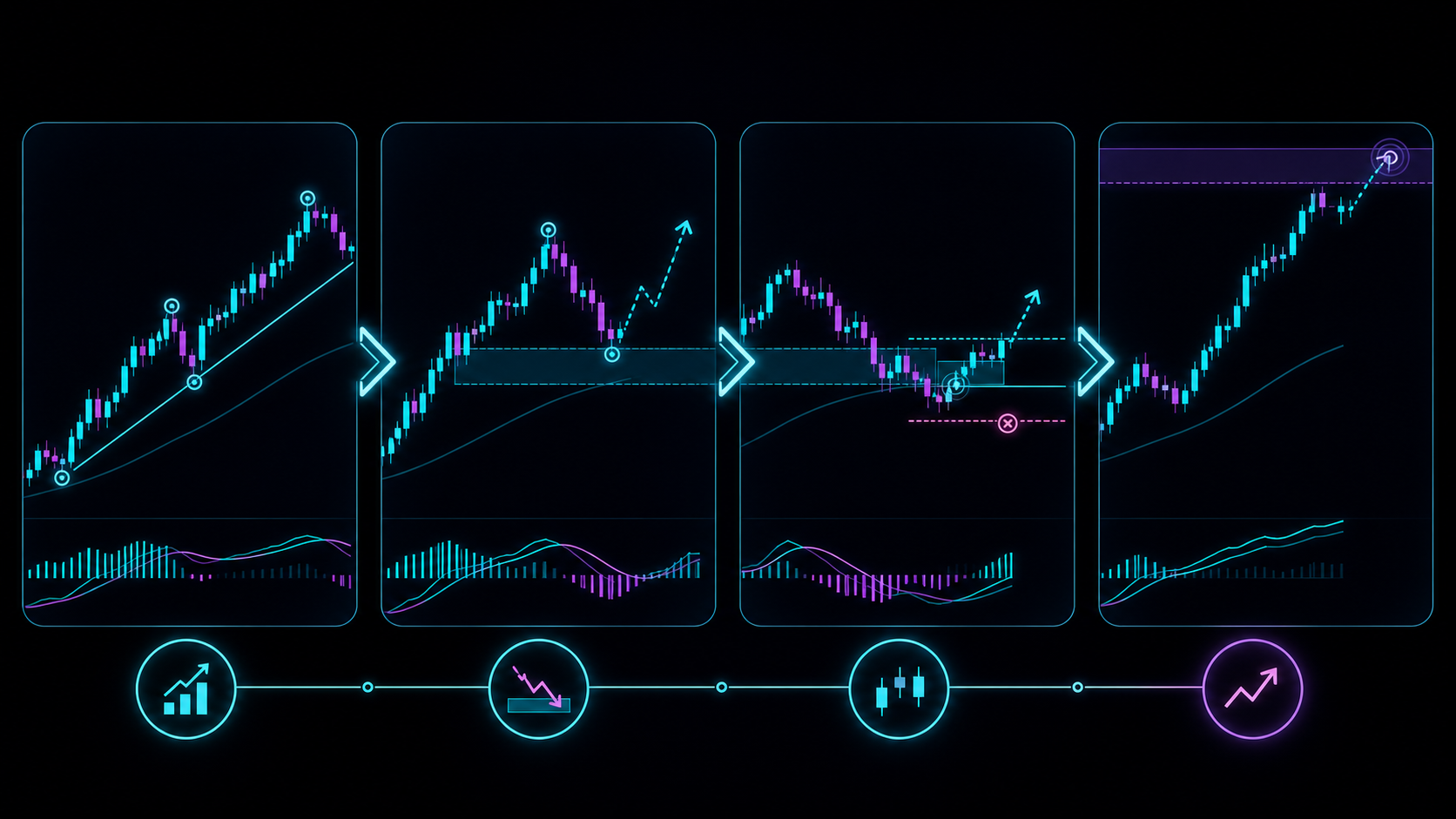
Choose the maximum account loss first, place the stop at the logical invalidation, then calculate a position size that connects those two decisions.
The Core Formula
For a simple linear product:
position quantity = maximum currency risk ÷ risk per unit
Where:
risk per unit = distance between entry and stop
If you risk $50 and each unit would lose $2 at the stop:
$50 ÷ $2 = 25 units
Fees, slippage, contract multipliers, currency conversion, and nonlinear products require adjustments.

The Correct Planning Order
- Identify the setup.
- Mark structural invalidation.
- Place the stop beyond invalidation with an appropriate buffer.
- Choose maximum account risk.
- Calculate position size.
- Verify liquidity, margin, and total exposure.
Do not move a logical stop closer merely to afford a larger position.
Wider Stops Need Smaller Positions
Two trades can risk the same account amount:
| Stop distance | Required position size |
|---|---|
| Narrower | Larger |
| Wider | Smaller |
This allows different markets and timeframes to use one consistent risk budget.
Include Realistic Execution
The actual loss may exceed the clean formula because of:
- spread;
- entry and exit fees;
- stop slippage;
- gaps;
- funding or borrowing;
- contract specifications.
Leave a buffer when these costs are meaningful.
Position Size Is Not Leverage
Position size determines exposure and PnL sensitivity. Leverage determines how much margin supports that exposure.
Calculate safe position size first. Then choose leverage only if necessary to support it without bringing liquidation near the planned stop.
Portfolio-Level Sizing
Reduce size when:
- several positions share the same directional exposure;
- liquidity cannot support the intended order;
- volatility exceeds the tested range;
- the strategy is already near its drawdown limit.
A position can be correctly sized alone and still be too large inside the portfolio.
Using ZenAlgo Context
Grid helps mark meaningful swings and potential invalidation areas. Levels provides objective reference zones.
These tools help locate a stop; they do not decide how much account equity to risk.
Common Mistakes
- Choosing a position size based on desired profit.
- Using the full amount the platform permits.
- Confusing margin with risk.
- Ignoring fees and slippage.
- Using the same quantity for every market.
- Tightening the stop to increase size.
Key Takeaways
- Position size connects stop distance with maximum account loss.
- Define invalidation before calculating quantity.
- Wider stops require smaller positions for equal risk.
- Include execution costs and portfolio correlation.
- Leverage is selected after position size, not before it.
Continue Learning
- Learn how to place a stop loss.
- Understand risk per trade.
- Explore Grid for structure-based planning.
Position-sizing formulas estimate planned loss. Gaps, slippage, and market failures can produce larger actual losses.