Risk of Ruin Explained
Risk of ruin is the probability that losses reduce capital so severely that the strategy can no longer continue or recover practically.
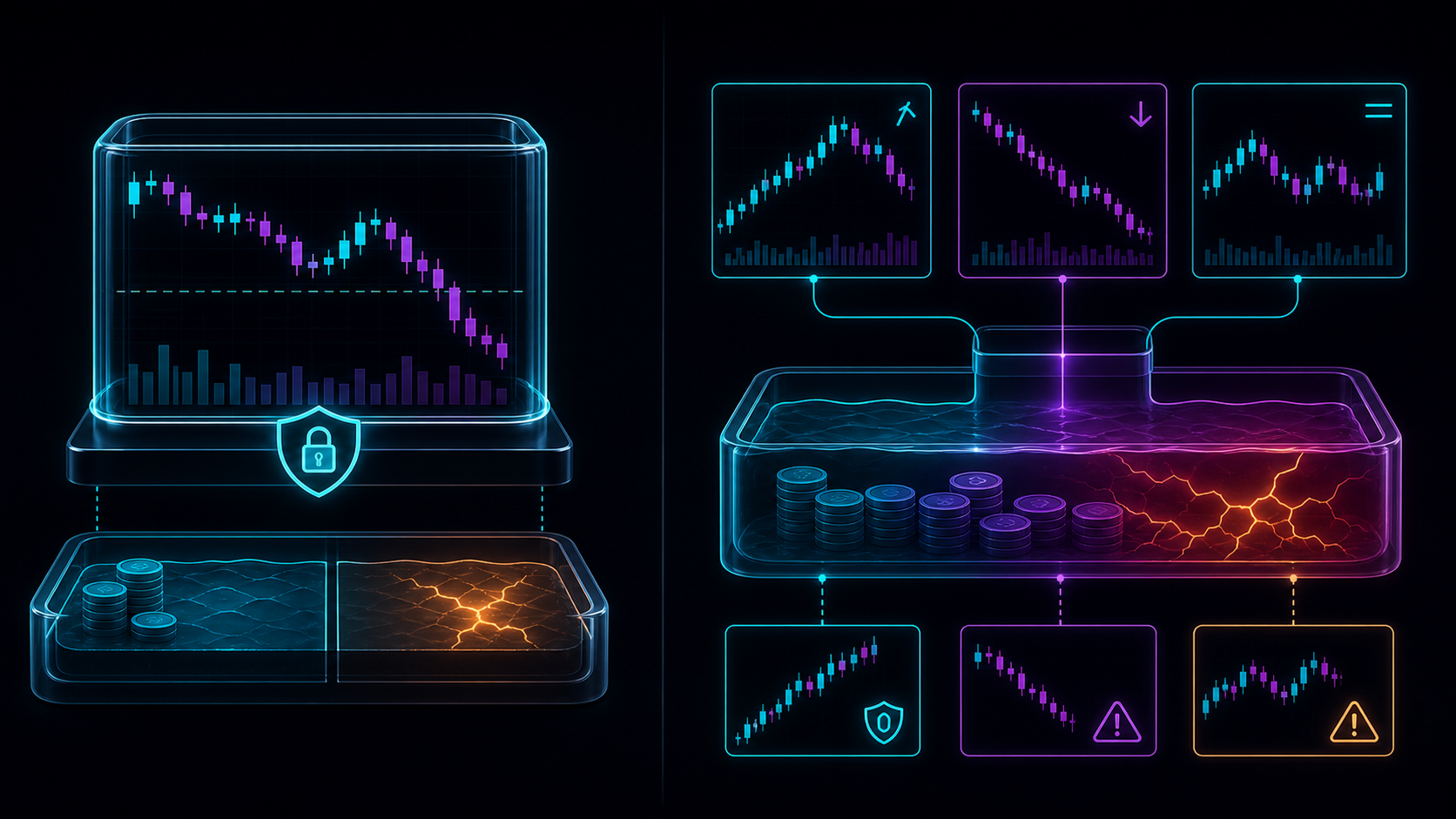
Risk of ruin rises when risk per trade is large, expectancy is weak, outcomes are volatile, positions are correlated, or leverage creates forced exits. Survival improves by keeping losses bounded and preserving enough capital for the edge to play out.
Ruin Does Not Always Mean Zero
An account can be functionally ruined before reaching zero.
Examples:
- margin is insufficient to place the strategy's minimum position;
- drawdown becomes emotionally untradeable;
- recovery requires unrealistic returns;
- trading capital is needed for living expenses;
- the trader abandons the tested process.
Define ruin based on practical ability to continue.
What Drives Risk of Ruin?
- Risk per trade.
- Strategy expectancy.
- Variance of wins and losses.
- Losing-streak length.
- Correlated simultaneous exposure.
- Tail events and gaps.
- Leverage and liquidation.
- Execution costs and slippage.
- Rule violations.
Small changes in sizing can create large changes in survival probability.
Positive Expectancy Is Not Enough
A strategy can have positive expectancy and still fail if risk per trade is too large.
Imagine a strategy that should perform over hundreds of trades but risks a large portion of the account each time. A normal losing streak may destroy the account before long-term expectancy appears.
The edge needs enough attempts.
Correlation Makes Models Too Optimistic
Risk calculations often assume trades are independent. Real markets frequently move together during stress.
Several positions may lose simultaneously because they share:
- market direction;
- asset class;
- volatility factor;
- macroeconomic driver;
- liquidity conditions.
Aggregate plausible combined loss rather than counting each trade separately.
Tail Risk Matters
Historical samples may not include:
- exchange failures;
- sudden gaps;
- liquidity disappearance;
- extreme news;
- contract rule changes;
- unusually long losing streaks.
Risk planning needs a buffer for outcomes outside the expected distribution.
Reduce Risk of Ruin
- Use conservative risk per trade.
- Cap total correlated exposure.
- Avoid liquidation-dependent plans.
- Include costs and slippage.
- Stop increasing risk after losses.
- Maintain capital outside the trading account when appropriate.
- Pause and review when strategy behavior departs from expectations.
Key Takeaways
- Ruin means losing the practical ability to continue.
- Positive expectancy cannot protect an oversized account.
- Correlation and tail events make simple models optimistic.
- Conservative sizing buys the attempts an edge needs.
- Survival is a prerequisite for long-term performance.
Continue Learning
- Review risk per trade.
- Understand maximum drawdown.
- Learn how leverage changes risk.
Risk-of-ruin estimates depend on uncertain assumptions. Real losses can exceed modeled outcomes.