How to Place a Stop Loss
A stop loss should sit where the market proves the trade idea wrong, not where the loss happens to feel comfortable.
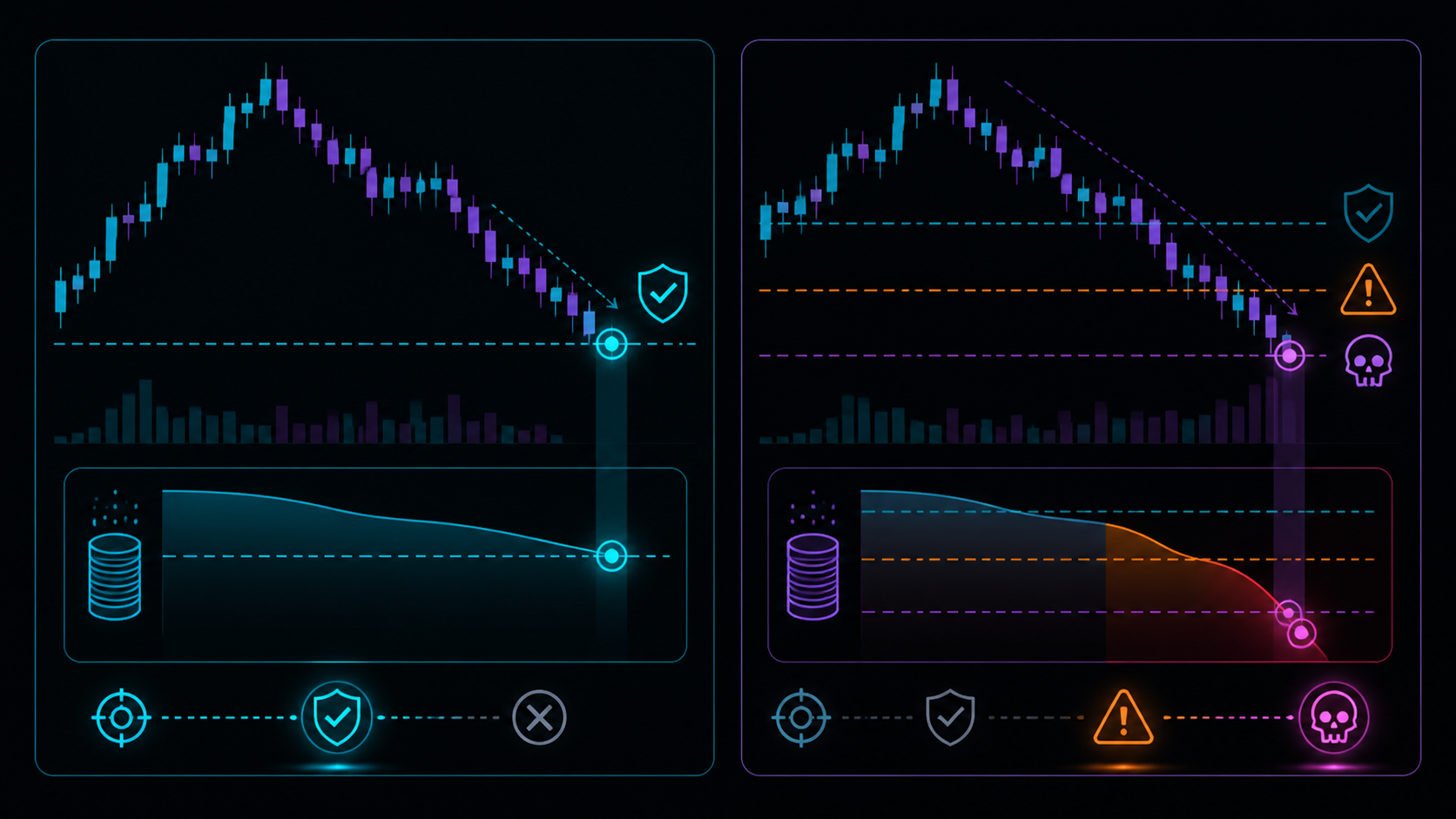
Define structural invalidation first, place the stop beyond it with enough room for normal variation, then reduce position size until the resulting account risk fits your limit.
Invalidation Comes Before the Stop
Invalidation is the market reason the trade thesis is no longer valid. The stop loss is the order used to exit when that point is reached.
Examples:
- a trend-continuation long may be invalidated below the higher low that must hold;
- a range-rejection short may be invalidated after price gains acceptance above resistance;
- a breakout trade may be invalidated when price returns and holds inside the old range.
A random fixed-distance stop may not correspond to the setup.
Common Stop Placement Methods
Structure-Based
Beyond a meaningful swing, range boundary, or breakout level.
Volatility-Based
Far enough from entry to tolerate normal movement for the instrument and timeframe.
Time-Based
Exit if the expected development does not occur within a defined period.
Thesis-Based
Exit when a specific market condition changes, even before a hard price stop.
Many strategies combine a hard protective stop with thesis-based management.
Add a Buffer Deliberately
Stops placed exactly at obvious highs, lows, or boundaries may trigger during normal tests.
A buffer can account for:
- typical volatility;
- spread;
- instrument tick size;
- brief liquidity sweeps;
- execution delay.
A larger buffer requires a smaller position to preserve account risk.
Stop Orders Can Slip
A stop-market order prioritizes exiting after the trigger but may fill at a worse price. A stop-limit order controls price but can remain unfilled.
Review trading order types and liquidity before assuming a stop guarantees maximum loss.
Do Not Move Stops to Avoid Being Wrong
Moving a stop farther after entry usually increases risk while preserving a broken thesis.
A stop may be adjusted only under predefined rules, such as:
- trailing behind new confirmed structure;
- reducing risk after the setup develops;
- responding to a tested time-based rule.
Never widen it impulsively because price is approaching.
Using ZenAlgo Reference Areas
Grid maps swings and structure. Levels provides objective reference areas.
Use them to ask where invalidation makes sense. Do not place stops mechanically at every displayed level.
A Stop Placement Checklist
- What must remain true for the trade to work?
- Which price behavior proves that condition false?
- Is the stop beyond normal noise?
- Could spread or slippage trigger or worsen the exit?
- Does the resulting position size fit account risk?
- Is liquidation safely beyond the planned stop?
Key Takeaways
- Invalidation is the reason; the stop is the execution tool.
- Structure and volatility should guide stop placement.
- Wider valid stops require smaller positions.
- Stops can slip or fail to fill.
- Never widen a stop without a predefined rule.
Continue Learning
- Calculate position size.
- Understand risk-to-reward.
- Review Grid and Levels.
Stop orders do not guarantee an exact exit price. Gaps, thin liquidity, and platform failures can increase loss.