Why Averaging Down Can Destroy an Account
Averaging down means adding exposure after price moves against a position, lowering the average entry price while increasing total risk.
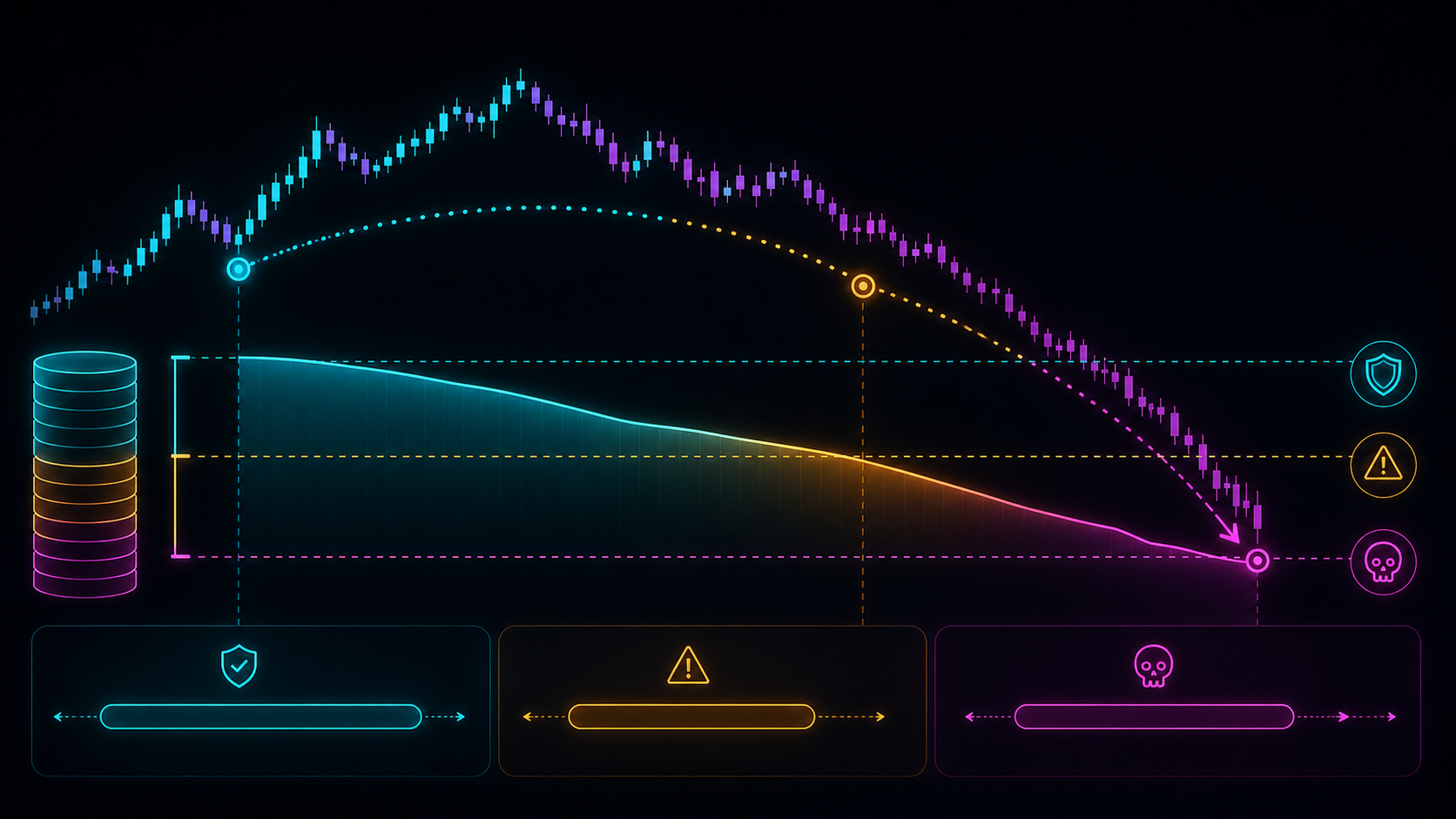
Averaging down can make a small initial error grow into an oversized position. Unless additions are predefined, independently sized, and supported by a tested strategy, the trader is usually increasing risk because the market disagrees.
A Better Average Entry Can Hide Worse Risk
Adding to a losing long reduces the average entry price. That looks attractive on the platform, but total position size becomes larger.
If price continues falling:
- losses accelerate;
- liquidation moves closer when leveraged;
- available capital declines;
- emotional attachment increases;
- exiting becomes harder.
The average entry improved while the account's situation worsened.
Why Traders Average Down Impulsively
- They want to avoid realizing a loss.
- The asset now appears “cheaper.”
- They believe price must return.
- They confuse conviction with evidence.
- A previous rescue attempt worked.
- The platform makes adding easy.
Temporary success reinforces a behavior that can eventually create catastrophic loss.
Averaging Down vs Planned Scaling
They are not the same.
Planned Scaling
- total maximum risk defined before entry;
- multiple entries specified in advance;
- invalidation remains fixed;
- final size remains within risk limit;
- setup is tested as a multi-entry strategy.
Impulsive Averaging Down
- additions decided after losses appear;
- invalidation moves or disappears;
- total risk grows unpredictably;
- position size is driven by emotion;
- exit depends on hoping for break-even.
Martingale Risk
Martingale-style behavior increases size after losses to recover previous losses with one win.
The problem is finite capital. A sufficiently long losing sequence or one extreme move can exceed the account's ability to continue.
Even a strategy with frequent wins can have unacceptable risk of ruin if losses grow without a hard cap.
What to Do Instead
- Define total risk before the first entry.
- Exit when invalidation occurs.
- Treat a new setup as a new decision.
- Reduce size during uncertainty.
- Review whether planned scaling actually improves expectancy.
- Never use additional margin to avoid accepting a broken thesis.
Key Takeaways
- Averaging down improves average entry while increasing exposure.
- Impulsive additions often remove invalidation discipline.
- Planned scaling must cap total risk before entry.
- Martingale behavior can hide risk until one streak destroys the account.
- Accepting a small planned loss is usually cheaper than defending a broken trade.
Continue Learning
- Understand risk of ruin.
- Learn how to place a stop loss.
- Review position sizing.
Averaging down and martingale strategies can create rapid, nonlinear losses and total account failure.