Momentum Explained
Momentum describes the force behind price movement. It helps answer whether a move is strengthening, fading, or disagreeing with price.
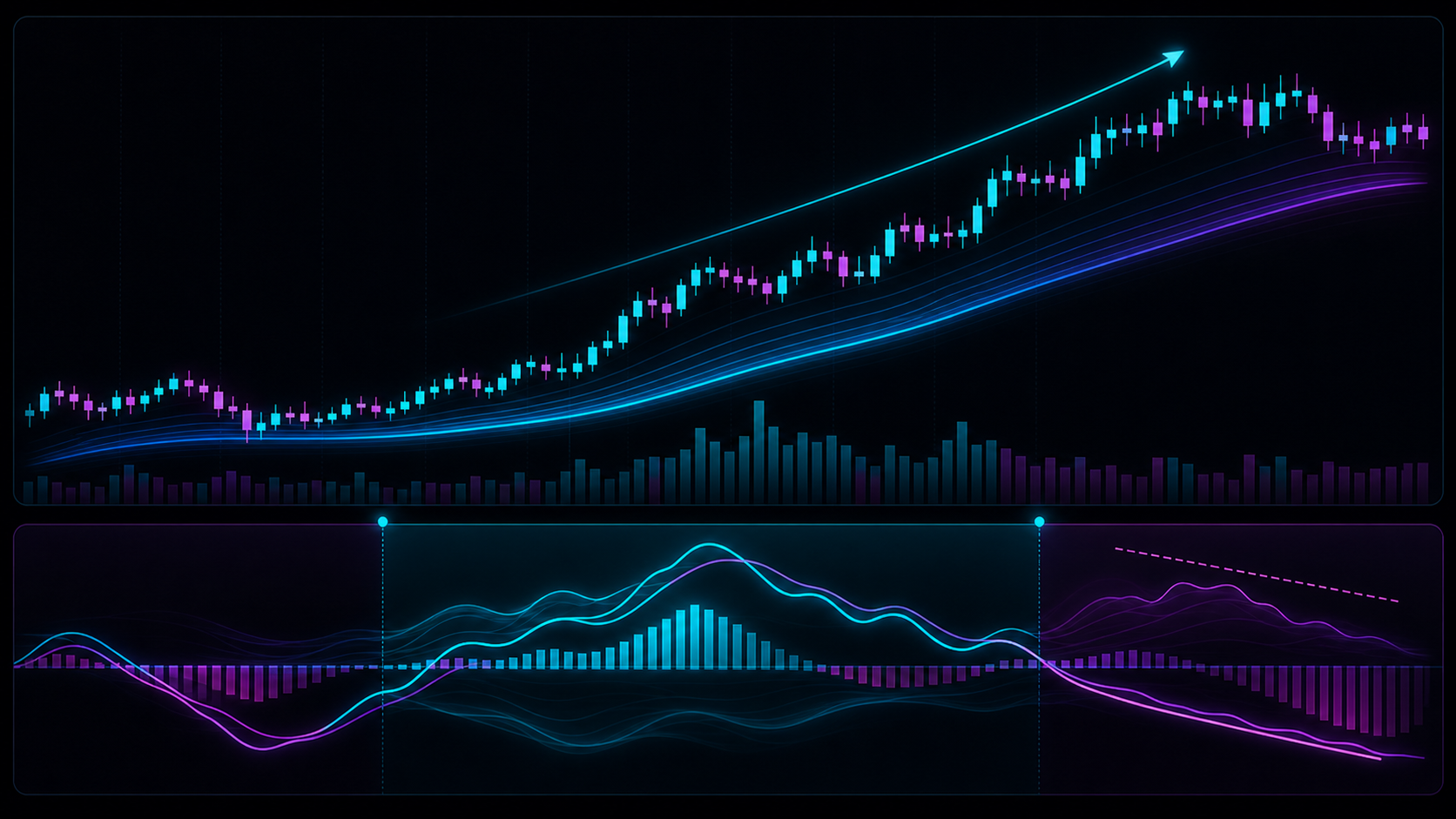
Momentum is not direction by itself. It measures how strongly price is moving or how an oscillator reacts to that movement. Momentum is most useful when compared with structure, trend, and location.
Price Momentum vs Indicator Momentum
Price momentum can be seen directly:
- larger candles;
- faster progress;
- shallow pullbacks;
- strong closes;
- breakout follow-through.
Indicator momentum translates price or volume behavior into a secondary reading, such as an oscillator, histogram, or signal line.
Momentum Can Confirm Price
Momentum supports a move when:
- price makes new highs and momentum also expands;
- bearish price movement is matched by strengthening downside momentum;
- pullbacks weaken while trend-direction pushes strengthen;
- volume or participation supports the movement.
Confirmation does not guarantee continuation. It says the evidence is aligned.
Momentum Can Warn
Momentum warns when:
- price makes progress but momentum fades;
- a breakout occurs with weak follow-through;
- oscillator highs are lower while price highs are higher;
- strong momentum appears directly into major opposition.
This does not mean reverse immediately. It means inspect context.
Momentum and Location
Momentum readings are more useful near meaningful areas:
- support or resistance;
- range boundaries;
- breakout levels;
- higher-timeframe value;
- trend pullback zones.
A divergence in the middle of a noisy range is less useful than one at a major level.
Using ZenAlgo Momentum Tools
Waves combines WaveTrend-style momentum, MoneyFlow, divergences, and multi-timeframe context. Advanced RSI shows momentum through RSI, its moving average, histogram, and divergences. Q provides a free momentum oscillator with histogram, bands, and divergence context.
Use them to answer a question:
- Is momentum strengthening?
- Is it fading?
- Does it agree with price?
- Does it agree across timeframes?
Common Mistakes
- Treating every crossover as an entry.
- Ignoring trend context.
- Trading divergence without a level or structure.
- Assuming strong momentum means good entry location.
- Using too many momentum tools that answer the same question.
Key Takeaways
- Momentum measures force or rate of change.
- Momentum can confirm or warn, but not guarantee.
- Location and trend context matter.
- Divergences are warnings, not automatic entries.
- One clean momentum tool is often enough.
Continue Learning
- Learn why overbought and oversold do not always mean reversal.
- Study trend strength vs direction.
- Explore Waves and Q.
Momentum signals can fail, lag, or reverse quickly. Always define invalidation and position size before acting.