Trend Strength vs Trend Direction
Trend direction tells you where price is progressing. Trend strength tells you how decisively it is progressing.
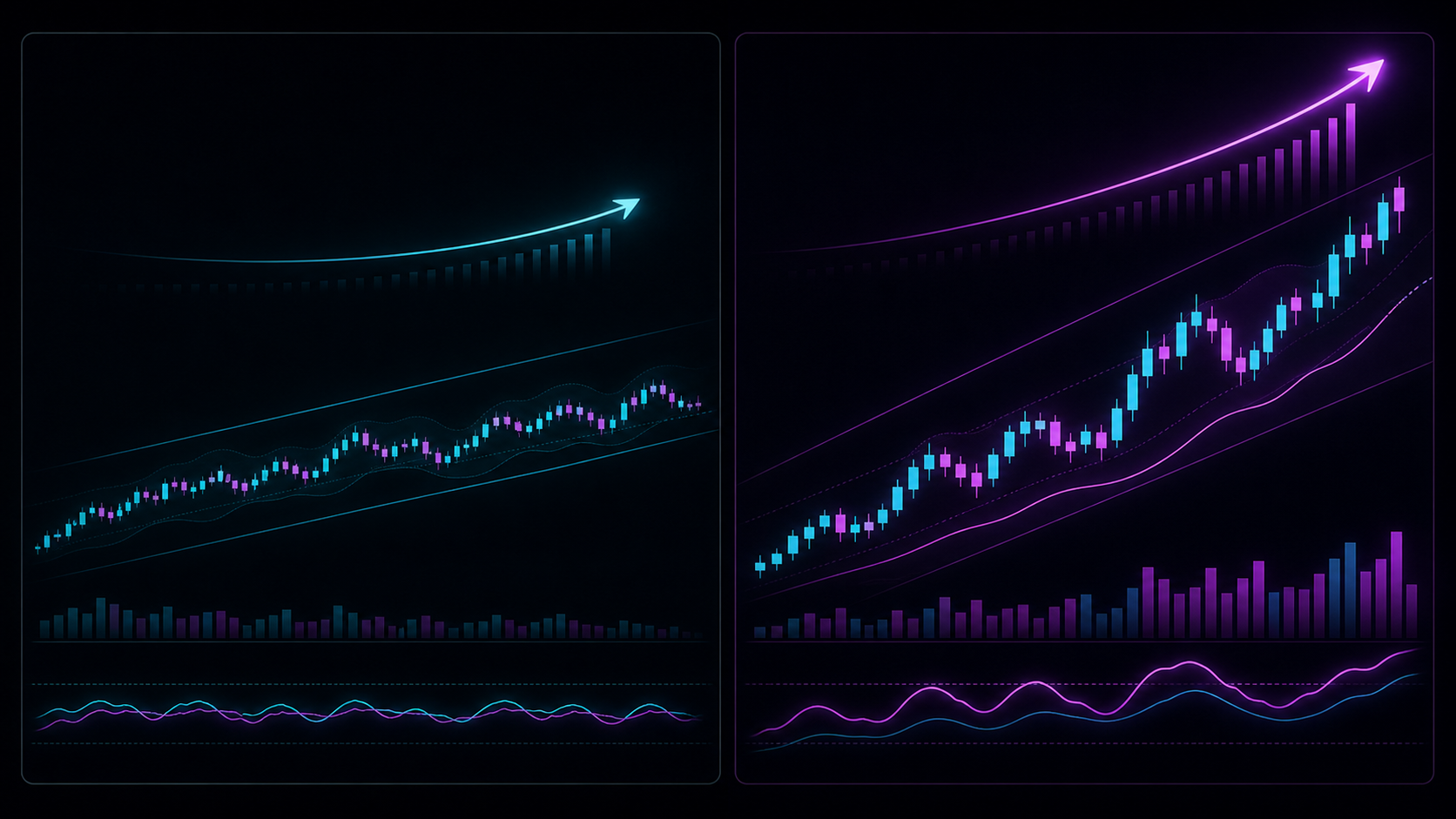
A market can be bullish but weak, bearish but exhausted, or directionless but volatile. Direction and strength are separate filters: direction helps choose the side, strength helps judge whether the condition is worth trading.
Direction Answers “Which Way?”
Direction comes from:
- higher highs and higher lows;
- lower lows and lower highs;
- price above or below value;
- moving-average slope;
- trend-state tools.
Avenger and Haze are useful for reading directional context.
Strength Answers “How Decisive?”
Strength comes from:
- size and consistency of directional moves;
- depth of pullbacks;
- volatility expansion in the trend direction;
- momentum agreement;
- ADX-style directional strength.
ADX is designed for trend strength context. It does not tell you whether the market is bullish or bearish by itself; it helps judge whether directional movement is strong or weak.
Four Useful Combinations
| Direction | Strength | Practical meaning |
|---|---|---|
| Clear direction | Strong | Trend-following conditions may be favorable |
| Clear direction | Weak | Trend exists but may be choppy or late |
| Mixed direction | Strong movement | Volatility may be high but structure unclear |
| Mixed direction | Weak movement | Range or low-quality conditions |
This prevents a trader from assuming that every bullish market is a strong bullish market.
Strength Can Fade Before Direction Breaks
A trend may continue making progress while momentum weakens. This can happen before:
- a deeper pullback;
- a range;
- a reversal;
- a final exhaustion push.
Weakening strength is a warning to improve selectivity, not automatic reversal proof.
Common Mistakes
- Using strength indicators as directional signals.
- Ignoring weak trend conditions because direction is still technically intact.
- Shorting a strong uptrend because it is “overbought.”
- Assuming high volatility equals healthy trend strength.
Key Takeaways
- Direction and strength answer different questions.
- Strong direction can support trend-following tactics.
- Weak direction often requires patience or smaller expectations.
- Strength can fade before structure breaks.
- Use direction, strength, location, and risk together.
Continue Learning
- Learn momentum.
- Study market regimes.
- Explore ADX and Avenger.
Trend strength measures can lag or misread volatile ranges. They should not be used as standalone entries.