How to Identify a Market Trend
A trend is sustained directional progress. It is not one large candle, one indicator color, or one emotional feeling that price “should” continue.
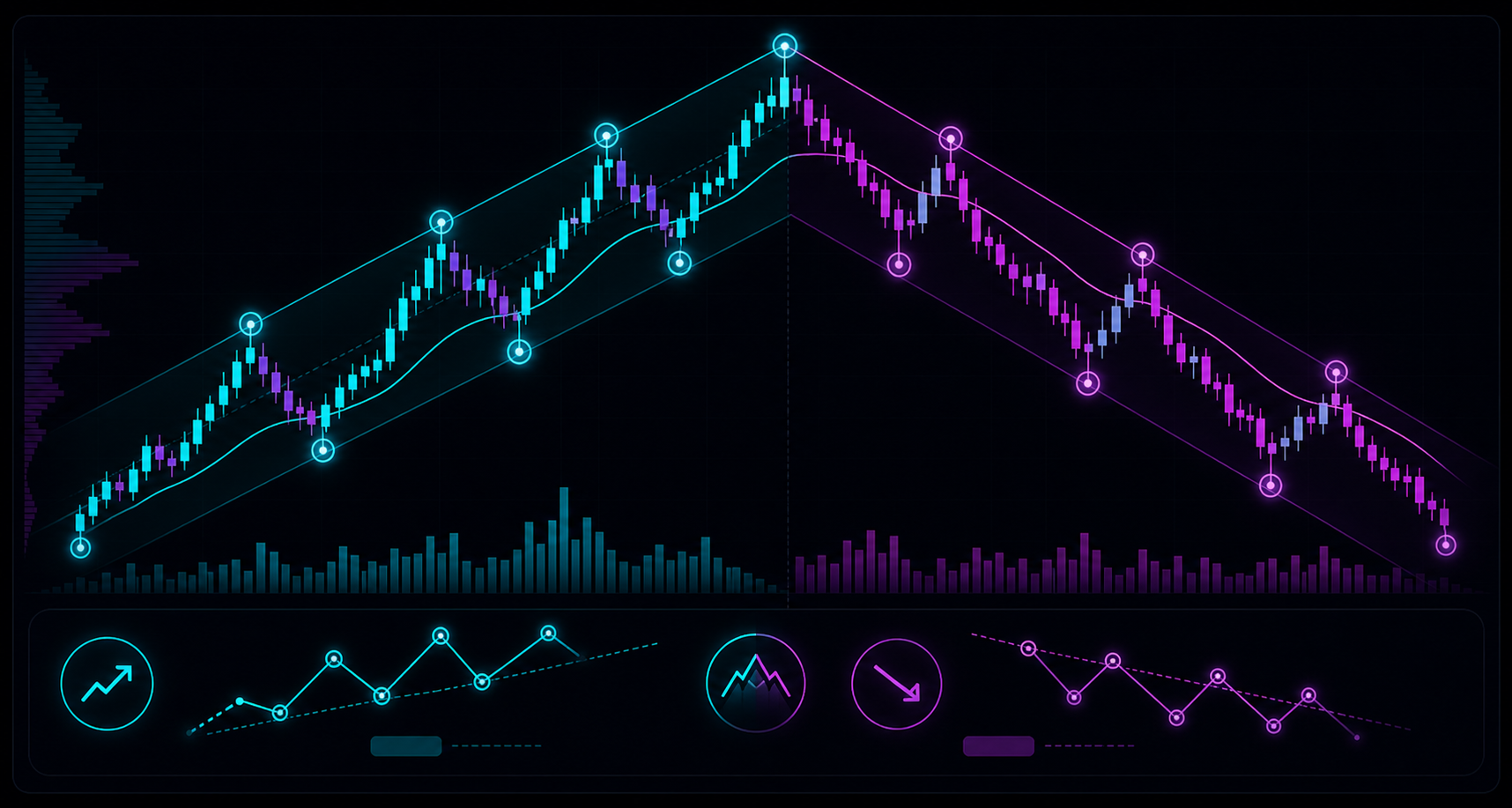
Identify a trend by combining structure, location, momentum, and persistence. An uptrend generally makes higher highs and higher lows; a downtrend makes lower lows and lower highs. Confirmation improves when price also holds on the correct side of value and momentum supports the direction.
Start With Structure
Structure is the first layer:
- uptrend: higher highs and higher lows;
- downtrend: lower lows and lower highs;
- range: overlapping swings without sustained progress;
- transition: previous structure weakening or breaking.
Review Market Structure before relying on indicators. Tools should simplify what price is already showing.
Add Location
Trend is easier to trust when price holds on the correct side of important reference areas.
Useful references include:
- previous swing highs and lows;
- broken resistance acting as support;
- broken support acting as resistance;
- VWAP or value areas;
- a moving average or trend line used consistently.
Avenger helps organize trend and value through its AVG, VWAP, and structure context.
Check Momentum and Participation
A trend with momentum usually shows directional candles that make progress. A trend losing momentum may still move in the same direction, but with weaker follow-through and deeper pullbacks.
Momentum tools such as Waves, Advanced RSI, and Q help answer whether pressure is strengthening or fading.
Use Persistence
One swing is not enough. A trend should persist across multiple decisions:
- price moves in the trend direction;
- pullbacks fail to reverse the structure;
- continuation appears again;
- the broader timeframe supports the same idea.
If direction changes every few candles, conditions are probably mixed or ranging.
Common Mistakes
- Calling every fast move a trend.
- Ignoring higher-timeframe structure.
- Treating a moving-average cross as complete context.
- Buying a trend after it is already too extended.
- Switching timeframe until the desired trend appears.
Key Takeaways
- Trend is sustained directional progress.
- Structure comes before indicators.
- Location and value help judge whether price is accepted.
- Momentum confirms or warns, but does not guarantee continuation.
- Persistence separates real trend from short-term noise.
Continue Learning
- Learn why trading with the trend improves your odds.
- Compare trend strength and direction.
- Explore Avenger.
Trends can reverse or fail without warning. Trend identification does not replace stop placement and risk control.