Overbought and Oversold Do Not Always Mean Reversal
Overbought means momentum is stretched to the upside. Oversold means momentum is stretched to the downside. Neither condition guarantees a reversal.
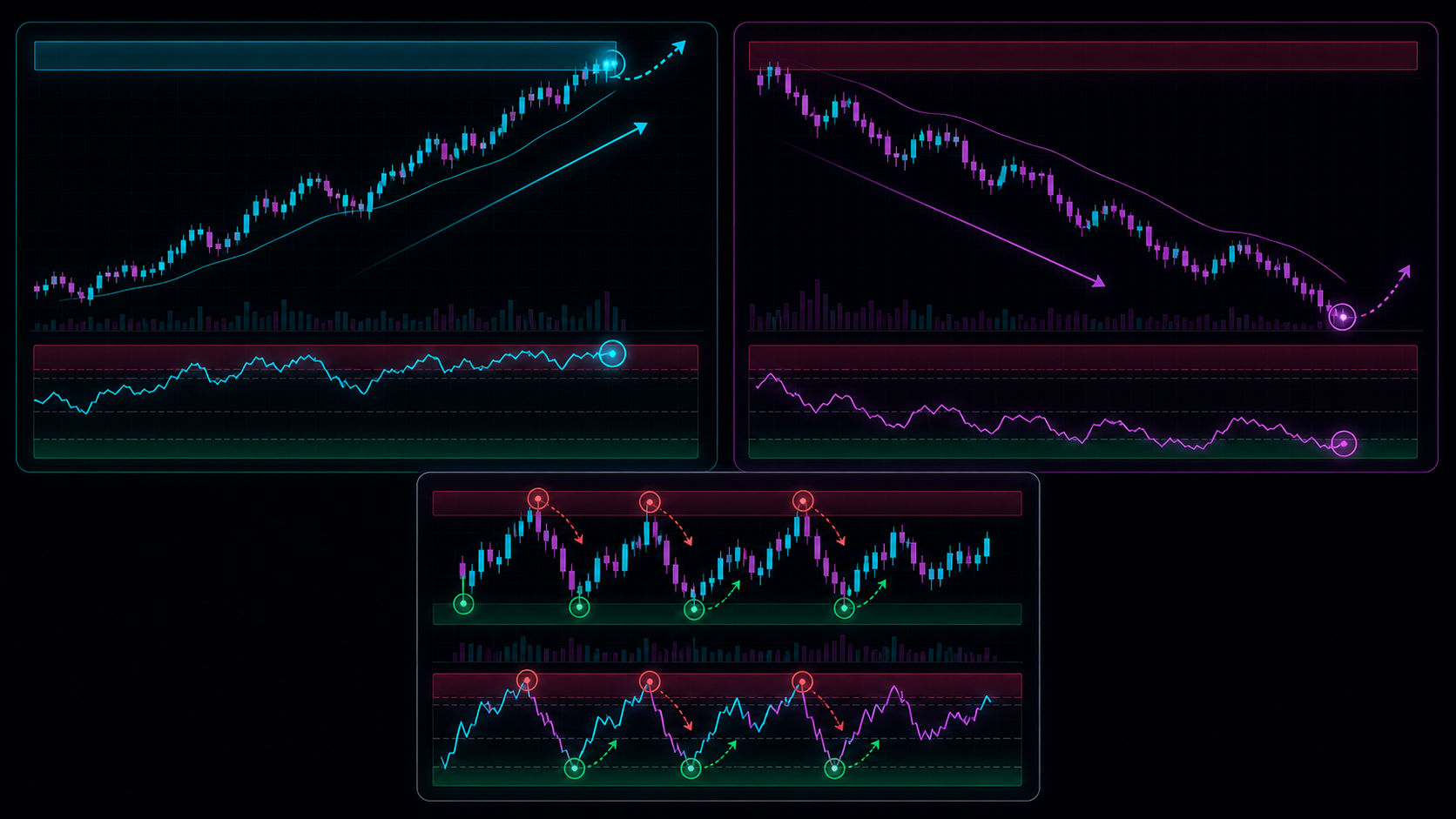
Overbought and oversold readings are context zones. In ranges, they may warn of exhaustion near boundaries. In strong trends, they can persist while price continues in the same direction.
Why the Terms Are Misleading
“Overbought” sounds like price must fall. “Oversold” sounds like price must rise.
In reality, a strong market can remain overbought because buyers keep accepting higher prices. A weak market can remain oversold because sellers keep pressing lower.
The reading says the move is stretched, not finished.
Context Changes Interpretation
| Market condition | Overbought may mean | Oversold may mean |
|---|---|---|
| Strong uptrend | Persistent bullish momentum | Possible pullback opportunity |
| Strong downtrend | Possible rally into resistance | Persistent bearish momentum |
| Range | Possible resistance reaction | Possible support reaction |
| Breakout | Expansion warning or confirmation | Expansion warning or confirmation |
This is why the same oscillator reading can produce opposite decisions in different regimes.
What Confirmation Looks Like
Before treating an extreme as reversal evidence, look for:
- reaction at a meaningful level;
- failure to continue;
- structural break;
- divergence;
- momentum cross back from the extreme;
- higher-timeframe context supporting the turn.
One extreme reading alone is not enough.
How ZenAlgo Tools Help
Advanced RSI keeps overbought and oversold levels but adds RSI-MA, histogram, divergences, and multi-timeframe context. Waves treats hot/cold zones as stretched conditions combined with MoneyFlow and crosses.
The key is to ask whether the extreme agrees with the broader market state.
Practical Examples
Trend Continuation
RSI remains overbought while price keeps forming higher highs and higher lows. Shorting only because RSI is high fights the condition.
Range Rejection
RSI becomes overbought at range resistance, then momentum rolls over and price rejects the boundary. Context makes the extreme more meaningful.
Exhaustion Warning
Price makes a new high at resistance while momentum makes a lower high. This is a warning to tighten criteria, not a blind short.
Key Takeaways
- Overbought and oversold are stretched conditions.
- Strong trends can remain stretched.
- Extremes are more useful near structure and value areas.
- Confirmation matters more than the label.
- Treat oscillator extremes as prompts to inspect context.
Continue Learning
- Study momentum.
- Learn market regimes.
- Explore Advanced RSI and Waves.
Trading against strong momentum can create rapid losses. Overbought and oversold readings should never replace risk controls.