Market Regimes Explained
A market regime is the broad environment in which price behavior occurs. It describes what type of tactics are more or less likely to fit current conditions.
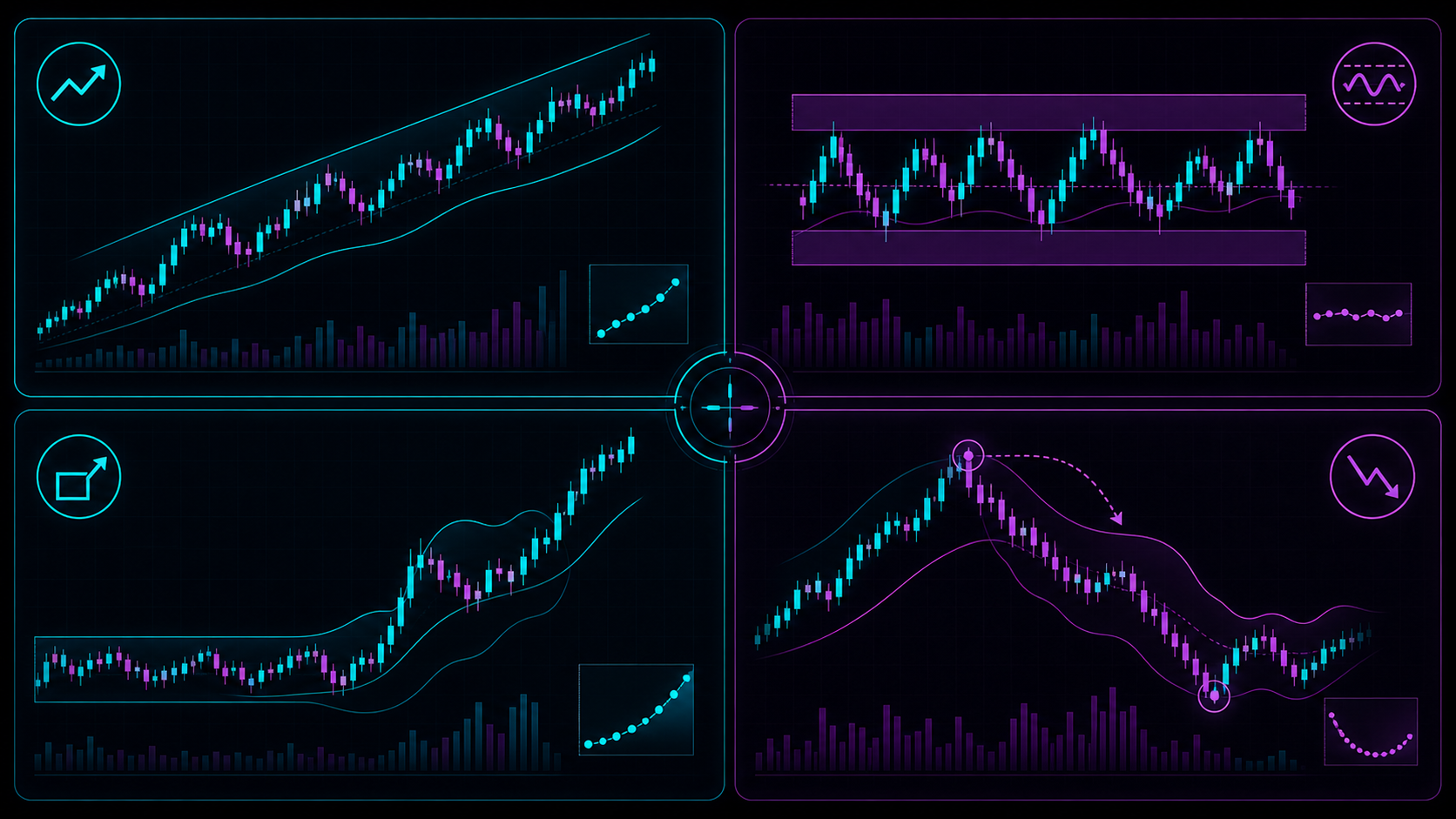
Market regimes help explain why the same setup can work in one environment and fail in another. Trend-following, range trading, breakout, and mean-reversion tactics require different conditions.
Imagine using the same setup for several weeks. At first it works beautifully. Pullbacks hold, entries trigger cleanly, and targets have room. Then, without changing the setup, results deteriorate. Breakouts fail. Pullbacks become reversals. Signals appear in both directions. The trader feels like the strategy suddenly forgot how to behave.
Often, the strategy did not change. The market did.
That is the purpose of regime reading. It helps you ask whether the environment still fits the tactic you are trying to use.
Regime Is Broader Than a Pattern
A pattern is local. A regime is environmental.
A breakout inside a broad expansion phase is different from a breakout inside a thin, choppy range. A pullback inside a strong trend is different from a pullback after trend strength has already faded. A mean-reversion signal near a range boundary is different from fading a strong directional move because price "looks too high."
Regime reading asks questions like: Is price directional or balanced? Is volatility expanding or compressing? Is momentum confirming or fading? Are related markets supportive? Is risk appetite broad or narrow?
Those questions decide what you should ignore as much as what you should trade.
Common Regime Types
In a trend regime, price makes directional swings and pullbacks tend to be defended. Trend-following and continuation tactics usually make more sense here than constant reversal attempts.
In a range regime, price rotates between boundaries. Mean reversion and range tactics may fit better, while breakout attempts need extra caution.
In compression, movement narrows and volatility contracts. This is often a preparation regime: mark levels, set alerts, and wait for expansion rather than forcing trades in the middle.
In expansion, price breaks away and volatility increases. Breakout and momentum tactics may become more relevant, but risk and slippage also become more important.
In transition, the previous behavior weakens. This is where traders often give back money because they keep using yesterday's tactic in today's market.
Using ZenAlgo Market Regime Tools
ZenAlgo has several tools that can help turn regime reading from a vague opinion into a repeatable checklist.
Use Crypto Trend first when you want macro context across Bitcoin, Ethereum, altcoins, dominance, stablecoin rotation, and dollar pressure. It can help answer whether the broader crypto environment is risk-on, risk-off, BTC-led, alt-led, or mixed.
Use Golden Vein when you want chart-level regime context from VWAP alignment, band behavior, and its built-in state table. Its bullish, bearish, super bullish, super bearish, and neutral states are useful for separating active expansion from quieter, less decisive conditions.
Then use Avenger and Channel to decide whether the specific chart in front of you agrees with that broader context.
Regime Filters Are Often Skip Filters
The most useful regime filter may not find a trade. It may keep you out of the wrong one.
If your strategy is designed for trend continuation and the market is choppy, the best trade may be no trade. If your mean-reversion setup appears during a strong expansion phase, waiting may be smarter than fading momentum. If volatility is compressed, the job may be preparation rather than execution.
This connects directly to When Not to Trade and How to Tag Trades by Setup and Market Regime. A regime label becomes most useful when you can review whether your setups actually performed in that condition.
Regime Can Change Slowly or Suddenly
Some transitions occur gradually: pullbacks deepen, trend strength fades, range boundaries form, and volatility compresses. Others happen quickly through news shocks, liquidation cascades, breakouts from long compression, or broad market correlation shifts.
Do not treat a regime label as permanent. Treat it as a working assumption that must be reviewed.
Continue Learning
- Compare trend, range, breakout, and reversal conditions.
- Study volatility expansion and compression.
- Learn how to adapt a strategy to market regimes.
- Practice top-down analysis.
Regime classification is interpretive and can be wrong. A market can change faster than a trader can react.