Multi-Timeframe Analysis
Multi-timeframe analysis compares the same market across different resolutions so you can separate broad context from local execution.
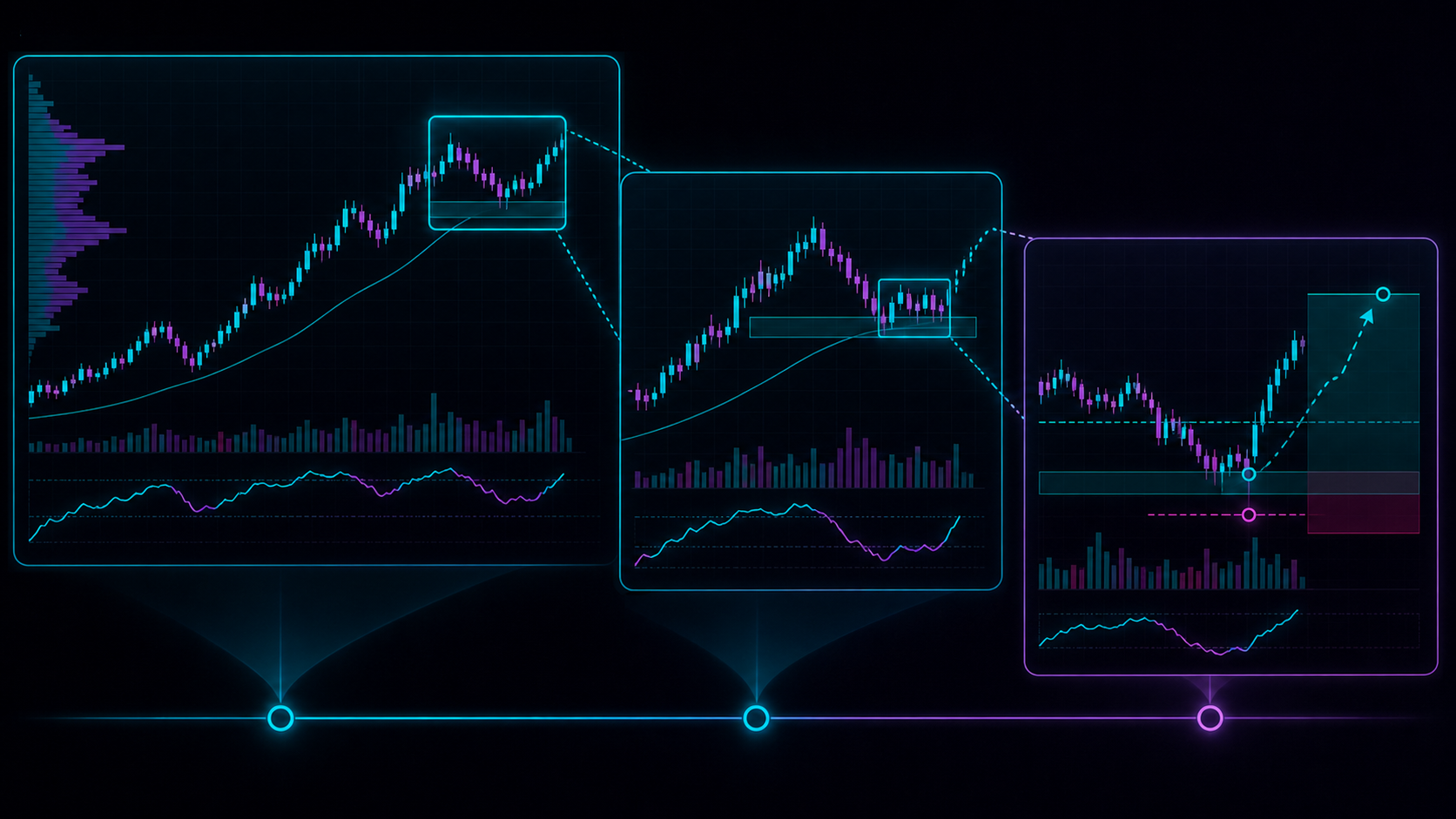
Use a higher timeframe for context, one decision timeframe for the setup, and a lower timeframe only if it improves execution. Too many timeframes create noise and contradictory excuses.
Assign Each Timeframe a Job
Context Timeframe
Defines broad trend, major levels, and regime.
Decision Timeframe
Defines the setup and invalidation.
Execution Timeframe
May refine entry timing or reduce stop distance, but should not override the trade thesis.
If every timeframe can cancel every other timeframe, the process is not defined.
Alignment Is Helpful, Not Mandatory
Strong alignment occurs when higher and lower timeframes support the same idea.
Misalignment does not automatically mean no trade, but it does require clarity:
- Is the trade a pullback inside a higher-timeframe trend?
- Is it a counter-trend scalp?
- Is the lower timeframe only execution detail?
- Which timeframe invalidates the idea?
Write the role before entering.
Avoid Timeframe Shopping
Timeframe shopping happens when traders keep changing charts until one supports the desired trade.
Prevent it by predefining:
- context timeframe;
- decision timeframe;
- execution timeframe;
- invalidation timeframe;
- when lower-timeframe signals are ignored.
Using ZenAlgo
Ultimate and Multiverse provide multi-timeframe context. They are most useful when the trader knows which timeframe owns the decision.
For example, an oversold lower-timeframe signal means something different when higher timeframes are strongly bearish than when they are broadly bullish.
A Practical Workflow
- Start with the higher timeframe.
- Mark major trend and value areas.
- Move to the decision timeframe.
- Define the setup and invalidation.
- Use the lower timeframe only for execution refinement.
- Return to the decision timeframe for management.
Key Takeaways
- Each timeframe needs a defined role.
- Higher timeframe gives context; decision timeframe owns the setup.
- Lower timeframe detail can improve or confuse execution.
- Alignment improves clarity but does not guarantee outcome.
- Avoid changing timeframes to justify trades.
Continue Learning
- Review Trading Timeframes Explained.
- Study market regimes.
- Explore Multiverse and Ultimate.
Multi-timeframe agreement can fail, and lower-timeframe precision can increase overtrading. Risk controls remain required.