How Trading Sessions Affect Price
Trading sessions change who is active, how much liquidity is available, and which ranges price is reacting to.
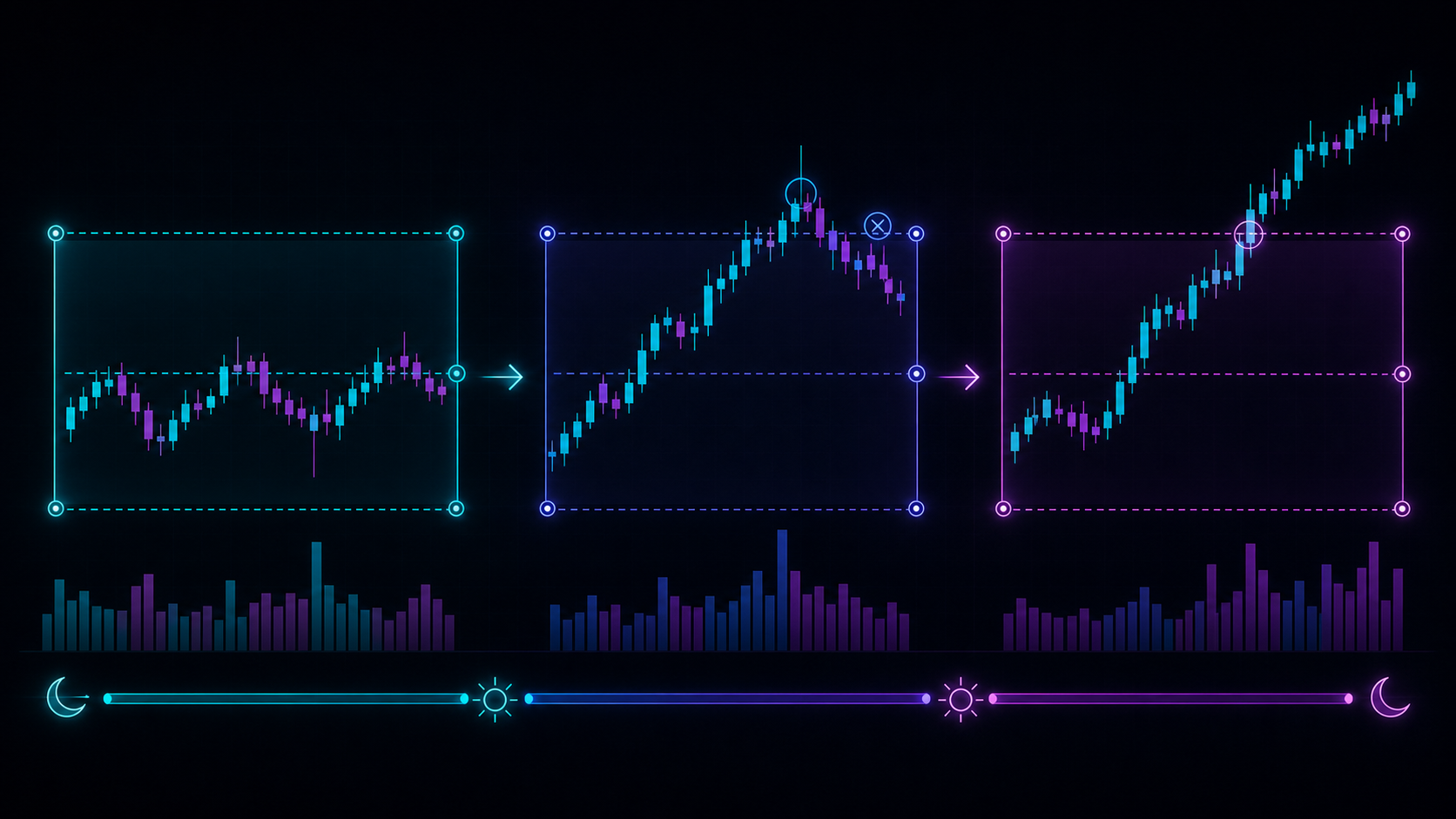
Sessions affect activity, volatility, and reference levels. A breakout during a liquid active session means something different from a thin move during quiet hours.
Why Sessions Matter
Different sessions bring different participants:
- local market opens and closes;
- institutional activity;
- news releases;
- liquidity provider behavior;
- overlap periods;
- handoff between regions.
The same price level can behave differently depending on when it is tested.
Session Ranges Become Reference Areas
A session high, low, and midpoint can act as intraday context.
Watch whether price:
- opens above or below a prior session range;
- accepts beyond a session high or low;
- rejects and returns into the range;
- holds the upper or lower half;
- expands during an active overlap.
Sessions makes these ranges visible and tracks session volume and delta.
Liquidity and Volatility Change
Active sessions often bring:
- tighter spreads;
- more volume;
- cleaner execution;
- stronger breakout attempts.
Quiet sessions may show:
- thinner liquidity;
- wider spread;
- choppy movement;
- false breaks;
- lower reliability for larger orders.
This varies by market.
Session Breakouts Need Acceptance
A price spike beyond a session high or low is not enough. Ask whether price remains outside the range or quickly returns.
Acceptance suggests the market is comfortable in the new area. Rejection suggests the breakout failed.
Common Mistakes
- Treating every session high or low as automatic reversal.
- Ignoring the market's actual active hours.
- Trading large size during thin conditions.
- Forgetting news scheduled inside a session.
- Comparing sessions without adjusting for instrument behavior.
Key Takeaways
- Sessions change liquidity, volatility, and participation.
- Session ranges create useful intraday reference areas.
- Active sessions often produce cleaner execution than quiet periods.
- Breakouts need acceptance, not only a wick.
- Session context should support, not replace, the setup.
Continue Learning
- Learn liquidity.
- Study volatility expansion and compression.
- Explore Sessions.
Session tendencies are not guarantees. News, liquidity shocks, and venue issues can override normal behavior.