Trading Timeframes Explained
A timeframe defines how much market activity each candle summarizes. It changes the level of detail you see, not the underlying market.
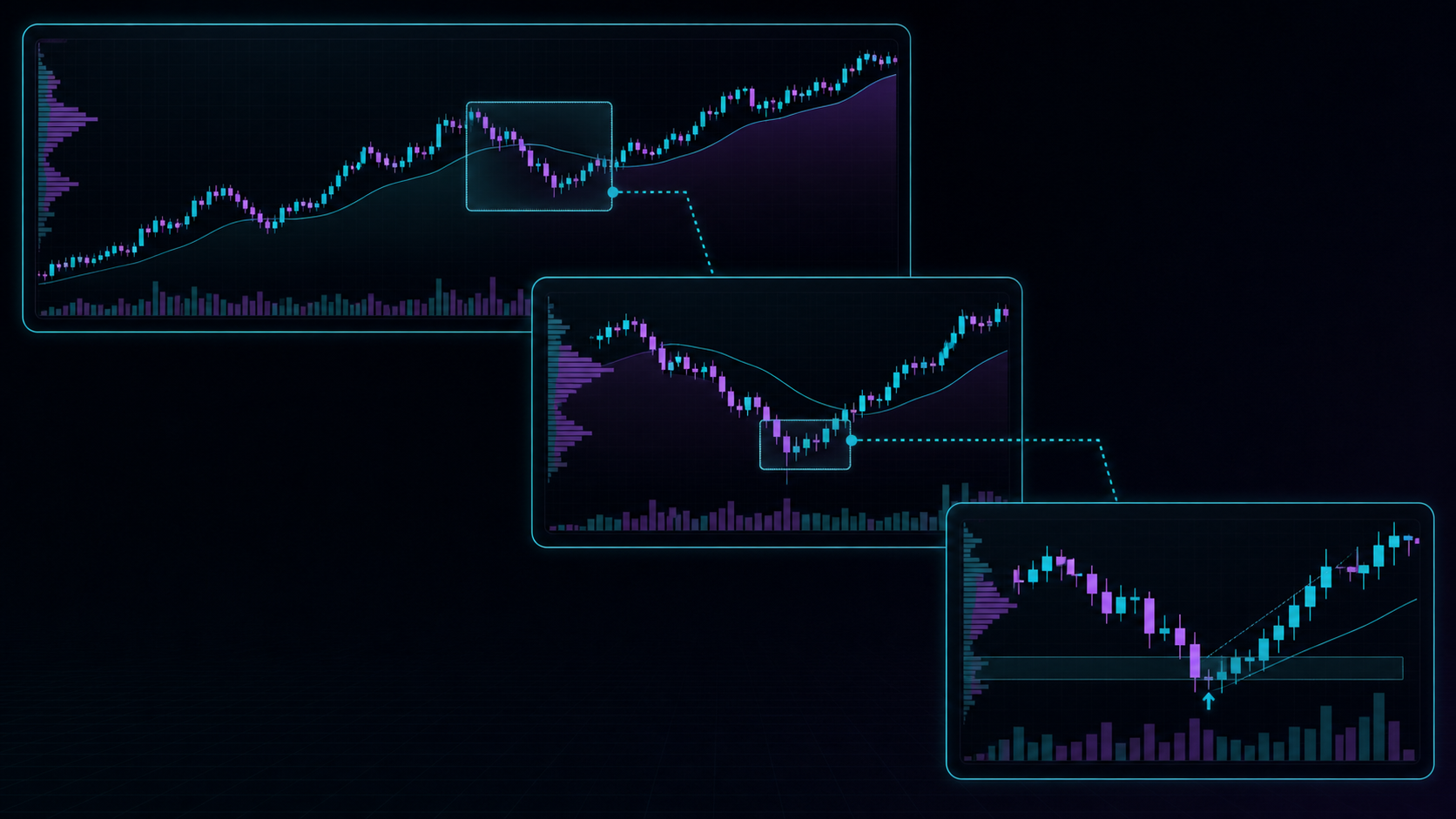
Choose a primary timeframe that matches how often you can make decisions. Use a higher timeframe for context and, only when useful, a lower timeframe for precise execution.
What a Timeframe Changes
On a five-minute chart, each candle represents five minutes. On a daily chart, each candle represents one trading day.
Lower timeframes show more detail and noise. Higher timeframes compress activity and make major structure easier to see.
| Lower timeframe | Higher timeframe |
|---|---|
| More candles and decisions | Fewer candles and decisions |
| More market noise | Clearer broad structure |
| Smaller typical moves | Larger typical moves |
| Greater sensitivity to fees and slippage | Longer holding periods |
| Faster feedback | Slower feedback |
Neither is inherently more profitable.
Match Timeframe to Your Real Life
Your timeframe should fit your availability and temperament.
- If you can monitor markets continuously, intraday timeframes may be practical.
- If you check charts around work or once per day, higher timeframes are more realistic.
- If rapid decisions cause stress or impulsive trades, slowing down can improve execution.
The “best” timeframe is one on which you can follow the strategy consistently.
Use a Three-Layer Hierarchy
A practical framework:
- Context timeframe: What is the broad condition?
- Decision timeframe: Is a valid setup forming?
- Execution timeframe: Can the entry and invalidation be refined?
Not every strategy needs all three. Adding more timeframes can create contradictions rather than clarity.
Why Timeframes Appear to Disagree
A market can be:
- bullish on the daily chart;
- pulling back on the four-hour chart;
- briefly bearish on the fifteen-minute chart.
These views are not necessarily contradictory. They describe different parts of the same movement.
The important question is which timeframe owns your trade idea. A lower-timeframe fluctuation should not invalidate a higher-timeframe plan unless your rules say it does.
Avoid Timeframe Shopping
Timeframe shopping means changing charts until one supports the trade you already want.
Prevent it by defining in advance:
- the timeframe used for context;
- the timeframe that creates the setup;
- the timeframe that defines invalidation;
- whether a lower-timeframe entry is allowed.
Multiverse helps compare multiple market perspectives, while Ultimate brings several forms of context into one workflow.
A Practical Selection Process
- Estimate how long you want trades to last.
- Choose a decision timeframe with manageable signal frequency.
- Select one higher timeframe, usually several multiples above it.
- Add a lower execution timeframe only if it measurably improves results.
- Backtest the exact hierarchy.
Key Takeaways
- A timeframe controls how market activity is grouped.
- Lower timeframes contain more detail and noise.
- Higher timeframes reveal broader structure.
- Your decision timeframe should match your strategy and schedule.
- Define timeframe roles before entering a trade.
Continue Learning
- Study market structure.
- Learn pullbacks vs reversals.
- Explore Multiverse for multi-timeframe context.
Lower timeframes can increase decision frequency, transaction costs, and execution risk. More opportunities do not guarantee better results.