Trend Trading Explained
Trend trading aligns decisions with sustained directional structure instead of repeatedly trying to predict the exact top or bottom.
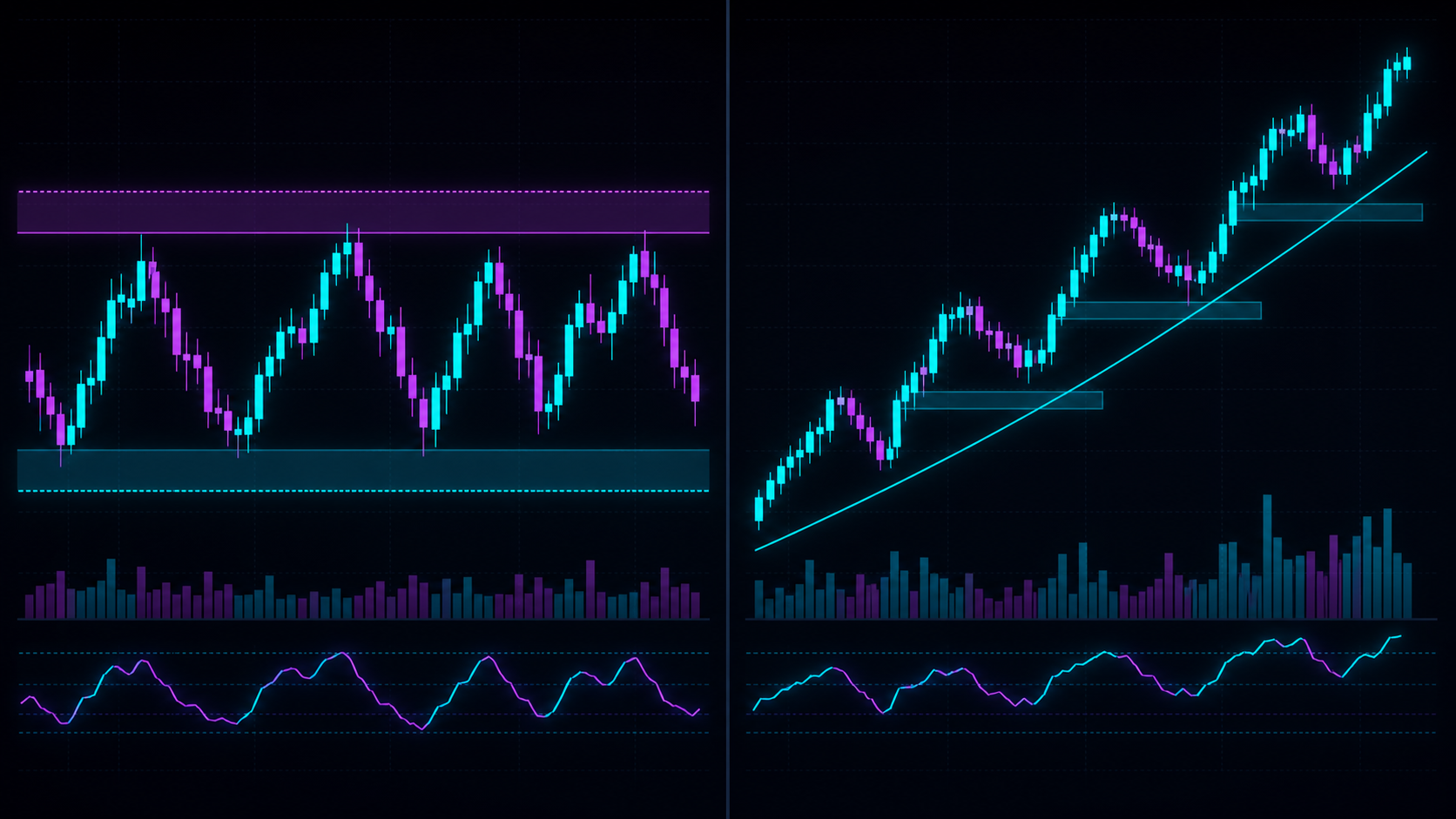
Trend traders seek setups in the direction of established market structure. They usually enter during pullbacks, breakouts, or resumptions and exit when the trend weakens, the setup is invalidated, or a target is reached.
Why Trade With the Trend?
In a healthy trend, directional pressure repeatedly overcomes counter-trend reactions.
Trading with that direction can provide:
- alignment with established structure;
- clearer invalidation behind meaningful swings;
- potential for extended moves;
- fewer attempts to identify exact turning points;
- a consistent filter for rejecting setups.
Trend alignment improves context, not certainty.
How to Identify a Trend
Use multiple forms of evidence:
Structure
An uptrend forms higher highs and higher lows. A downtrend forms lower lows and lower highs.
Momentum
Directional moves tend to be stronger than counter-trend pullbacks.
Location
Price holds above broken resistance in an uptrend or below broken support in a downtrend.
Persistence
The condition continues across multiple swings rather than one large candle.
Avenger is designed to simplify trend direction and structure. Haze and [Channel] context can help evaluate persistence and boundaries.
Common Trend Entry Styles
| Entry style | What the trader waits for |
|---|---|
| Pullback | Price retraces into support or value, then resumes |
| Breakout | Price clears a meaningful continuation boundary |
| Retest | Broken resistance or support holds from the other side |
| Momentum continuation | Directional strength returns after consolidation |
Each style needs explicit confirmation and invalidation rules.
Trend Strength Is Not Trend Direction
A market can be bullish but weak, or bearish but losing momentum.
Direction answers where price is progressing. Strength answers how decisively it is progressing.
Avenger helps with trend context, while ADX-style analysis helps distinguish strong directional movement from weak or mixed movement.
The Risk of Entering Too Late
A visible trend can still be overextended.
Before entering, ask:
- How far is price from a logical invalidation point?
- Is the next resistance or support too close?
- Has price already made several extended directional pushes?
- Is momentum strengthening or fading?
- Does the setup still offer acceptable reward-to-risk?
Correct direction with poor location can still create a bad trade.
When a Trend May Be Ending
Watch for:
- failure to make a new structural extreme;
- deeper counter-trend moves;
- a break of an important swing;
- failed recovery after the break;
- transition into overlapping range behavior;
- disagreement from broader market context.
Do not assume one weak candle ends a trend. Let the evidence accumulate.
A Practical Trend Workflow
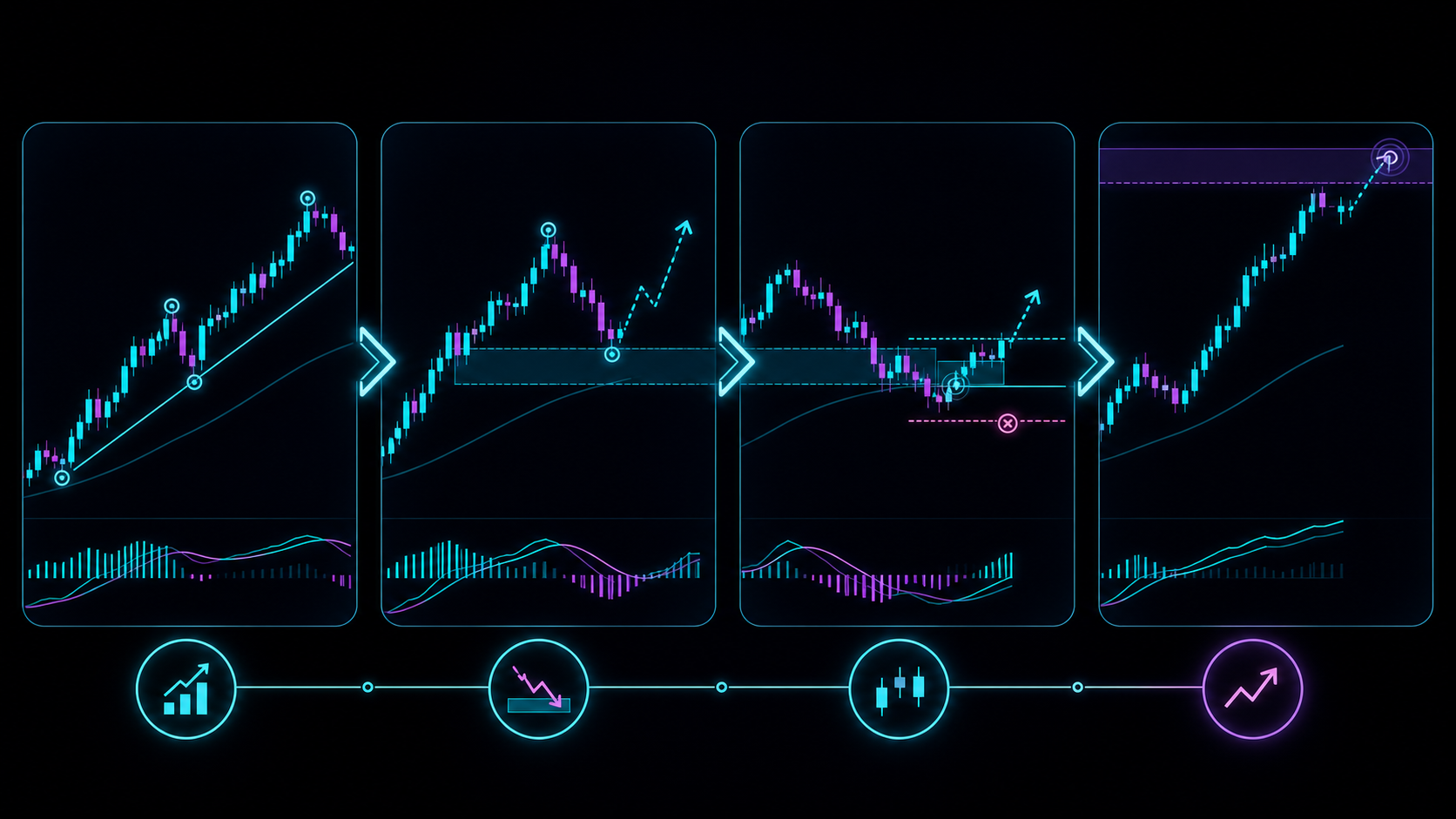
- Define direction on the context timeframe.
- Mark important structure and nearby obstacles.
- Wait for a pullback, breakout, or retest setup.
- Confirm the setup on the decision timeframe.
- Define actual-price entry, invalidation, and target.
- Size the position before entering.
- Review rule adherence after the trade.
Key Takeaways
- Trend trading aligns setups with directional structure.
- Structure, momentum, location, and persistence identify trends.
- Pullbacks and retests often offer better location than chasing.
- Trend direction and trend strength are different.
- A trend filter improves context but cannot replace risk management.
Continue Learning
- Review market structure.
- Distinguish pullbacks from reversals.
- Explore Avenger as a trend-first tool.
Practice a Trend-First Workflow
Use the ZenAlgo trial to observe how Avenger classifies trend and structure across different markets. Record which pullbacks preserve structure and which ones transition into ranges or reversals.
Trends can reverse quickly, and trend-following strategies can experience repeated small losses during ranges. Always control position size.