Range Trading Explained
A trading range forms when price repeatedly rotates between support and resistance without sustained directional progress.
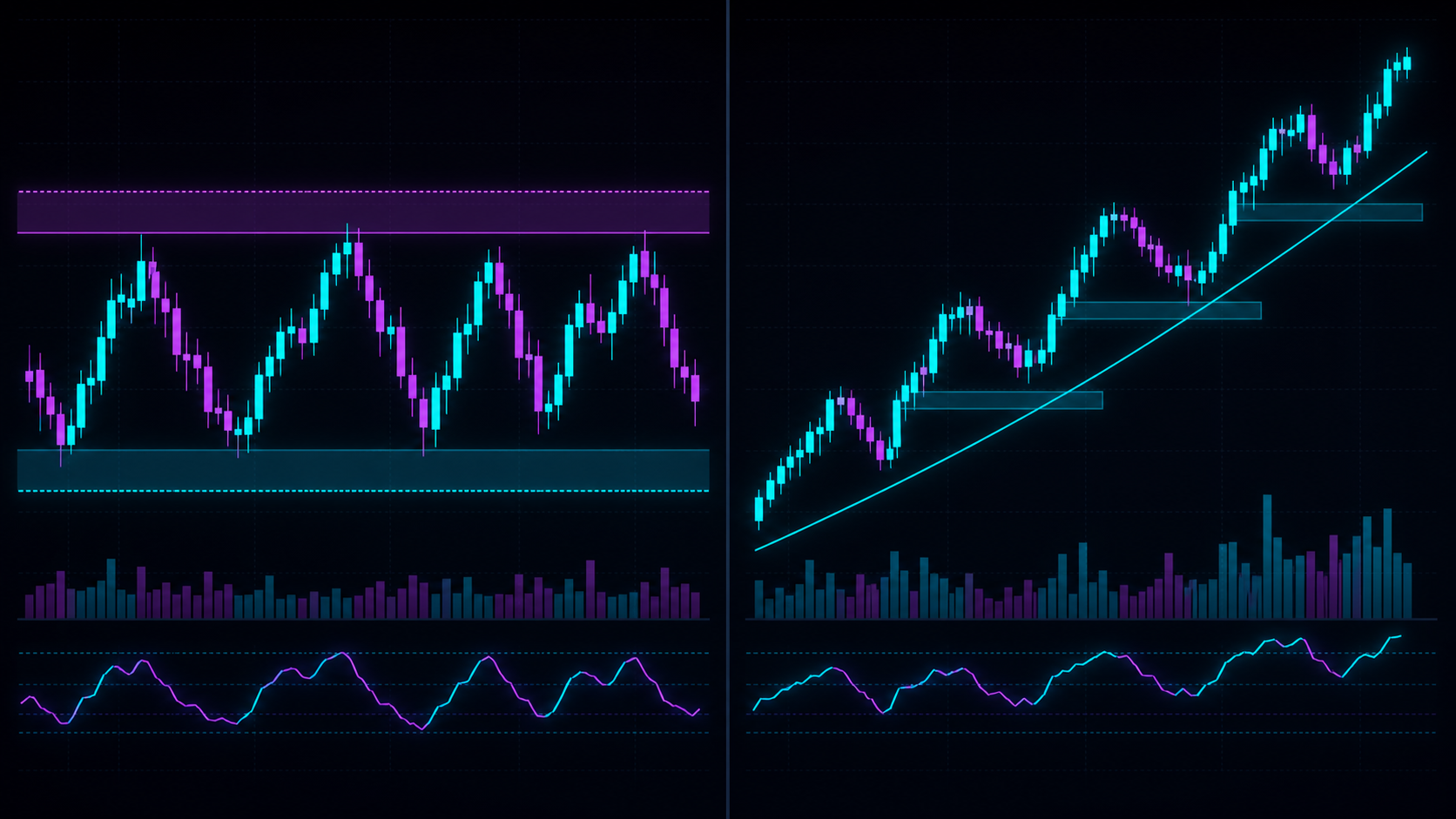
In a range, the market repeatedly rejects the boundaries and returns toward accepted value. Range traders usually avoid the middle, plan around the edges, and remain alert for an eventual breakout.
How to Identify a Range
A practical range usually has:
- visible upper and lower boundaries;
- repeated reactions from both sides;
- overlapping candles and swings;
- limited directional follow-through;
- frequent returns toward the center.
A range becomes more useful after price demonstrates that both boundaries matter.
The Three Range Areas
Upper Boundary
The upper area acts as resistance until price proves acceptance above it.
Lower Boundary
The lower area acts as support until price proves acceptance below it.
Middle or Value Area
The center often offers poor reward-to-risk because price can move unpredictably toward either side.
The edges provide clearer invalidation; the middle provides less information.
Range Logic vs Trend Logic
| Range condition | Trend condition |
|---|---|
| Expect rotation toward the center | Expect pullbacks to continue direction |
| Fade extremes after confirmation | Favor entries aligned with trend |
| Avoid chasing boundary breaks | Breakouts can be opportunities |
| Take profits before opposite edge | Allow room for continuation |
Using trend tactics inside a range often causes late entries near boundaries. Using range tactics in a strong trend can mean repeatedly trading against momentum.
A Range Trading Framework
- Confirm both boundaries.
- Avoid entering in the middle.
- Wait for rejection or failed breakout evidence near an edge.
- Place invalidation beyond the behavior that supports the trade.
- Plan realistic targets before the opposite boundary.
- Exit or reassess if price gains acceptance outside the range.
Boxer helps frame boxed market behavior. Ranger and Levels help visualize value and objective reference areas.
What Weakens a Range?
Watch for:
- repeated pressure against one boundary;
- shallower pullbacks away from that boundary;
- volatility compression near an edge;
- expanding activity during a break;
- closes and acceptance outside the range.
Repeated tests can weaken a boundary as resting orders are consumed.
Failed Breakouts in Ranges
A failed breakout briefly leaves the range and then returns. It can create a strong move toward the opposite side because breakout traders are forced to exit.
Do not assume every wick outside is a failed breakout. Wait for rejection and re-entry into the range.
Common Mistakes
- Trading before a range is clearly established.
- Entering in the center because price “looks cheap.”
- Assuming boundaries will hold forever.
- ignoring higher-timeframe trend pressure;
- targeting the exact opposite edge without accounting for risk.
Key Takeaways
- Ranges rotate between accepted boundaries.
- The middle usually offers the least useful location.
- Range tactics differ from trend tactics.
- Repeated boundary pressure can precede breakout.
- Acceptance outside the range invalidates the range thesis.
Continue Learning
- Study support and resistance.
- Learn breakouts and failed breakouts.
- Explore Boxer and Ranger.
Range boundaries can fail abruptly. Never assume sideways conditions will continue, and define risk before entering.