Pullbacks vs Reversals
A pullback temporarily moves against the prevailing trend. A reversal changes the prevailing direction. They often look similar at first, which is why confirmation matters.
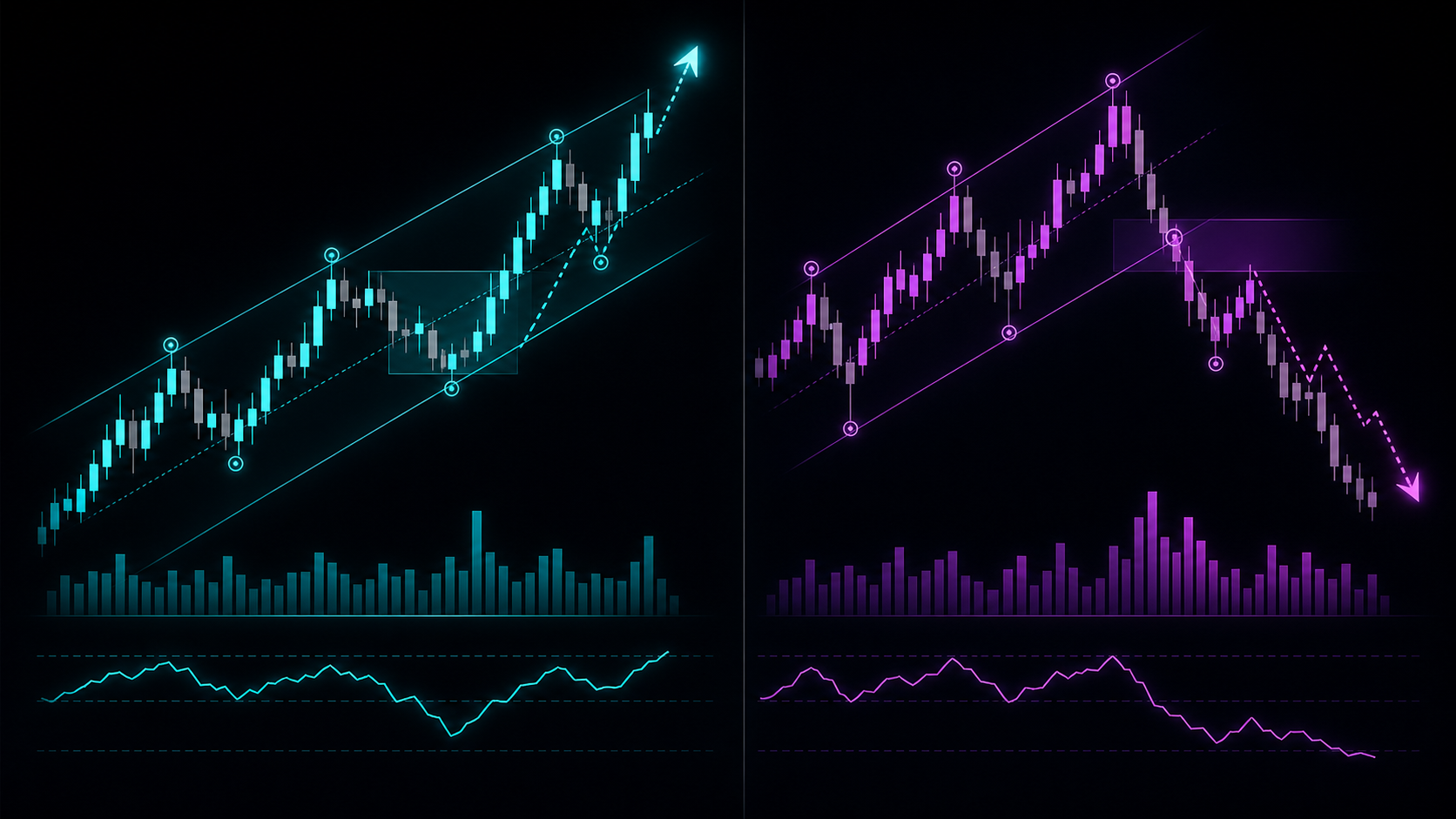
Treat counter-trend movement as a possible pullback while the important structure remains intact. A reversal becomes more credible after meaningful structure breaks, the old trend fails to recover, and the new direction gains follow-through.
What Is a Pullback?
In an uptrend, a pullback is a temporary decline before possible continuation. In a downtrend, it is a temporary advance.
Healthy pullbacks often:
- remain within the broader trend structure;
- approach previous breakout areas or value;
- show weaker counter-trend momentum;
- hold above a major higher low or below a major lower high;
- resume in the original direction after confirmation.
Pullbacks allow a market to rebalance without changing the dominant condition.
What Is a Reversal?
A reversal is a sustained change in direction.
Evidence grows when:
- the old trend stops making progress;
- an important structural swing breaks;
- price fails to reclaim the broken area;
- a new sequence of swings develops;
- momentum and broader context support the new direction.
No single signal proves a reversal at the exact turning point.
Compare the Evidence
| Evidence | More consistent with pullback | More consistent with reversal |
|---|---|---|
| Major structure | Intact | Broken |
| Counter-trend move | Weak or overlapping | Decisive and persistent |
| Retest of broken structure | Reclaimed quickly | Fails from the other side |
| Original trend progress | Resumes | Repeatedly fails |
| New swing sequence | Not established | Begins to form |
Why Traders Misclassify Them
Two emotional biases commonly appear:
- Trend attachment: assuming every decline is “just a pullback.”
- Turning-point obsession: calling every pause the exact top or bottom.
Both replace evidence with a preferred story.
Use Multiple Layers of Context
Start with structure, then consider:
- support and resistance;
- trend strength;
- momentum;
- volume and delta;
- higher-timeframe condition;
- broader related markets.
Avenger helps organize trend and structure. Haze and Waves can add trend and momentum context.
A Practical Decision Framework
When price moves against the trend:
- Mark the major swing that should hold.
- Observe the quality of counter-trend movement.
- Wait for either trend-resumption evidence or a meaningful break.
- If structure breaks, watch the retest.
- Act only when the scenario and invalidation are defined.
You do not need to identify the exact reversal candle. Waiting for evidence often means missing the first part of a move in exchange for greater clarity.
Common Mistakes
- Calling a reversal from one opposite-color candle.
- Ignoring the higher timeframe.
- moving invalidation repeatedly because “the trend will return.”
- entering counter-trend without a different risk plan.
- assuming oversold or overbought means reversal.
Key Takeaways
- Pullbacks move temporarily against a trend; reversals change it.
- Important structure is the primary dividing line.
- Failed recovery and a new swing sequence strengthen reversal evidence.
- Confirmation arrives after the turning point, not before it.
- Avoid both blind trend attachment and premature reversal calls.
Continue Learning
- Review market structure.
- Study trend trading.
- Explore Avenger and Waves.
Reversals are difficult to identify in real time. Counter-trend trading can carry elevated risk and requires strict invalidation.