Heikin Ashi vs Traditional Candles
Traditional and Heikin Ashi candles answer different questions. One preserves price precision; the other emphasizes directional clarity.
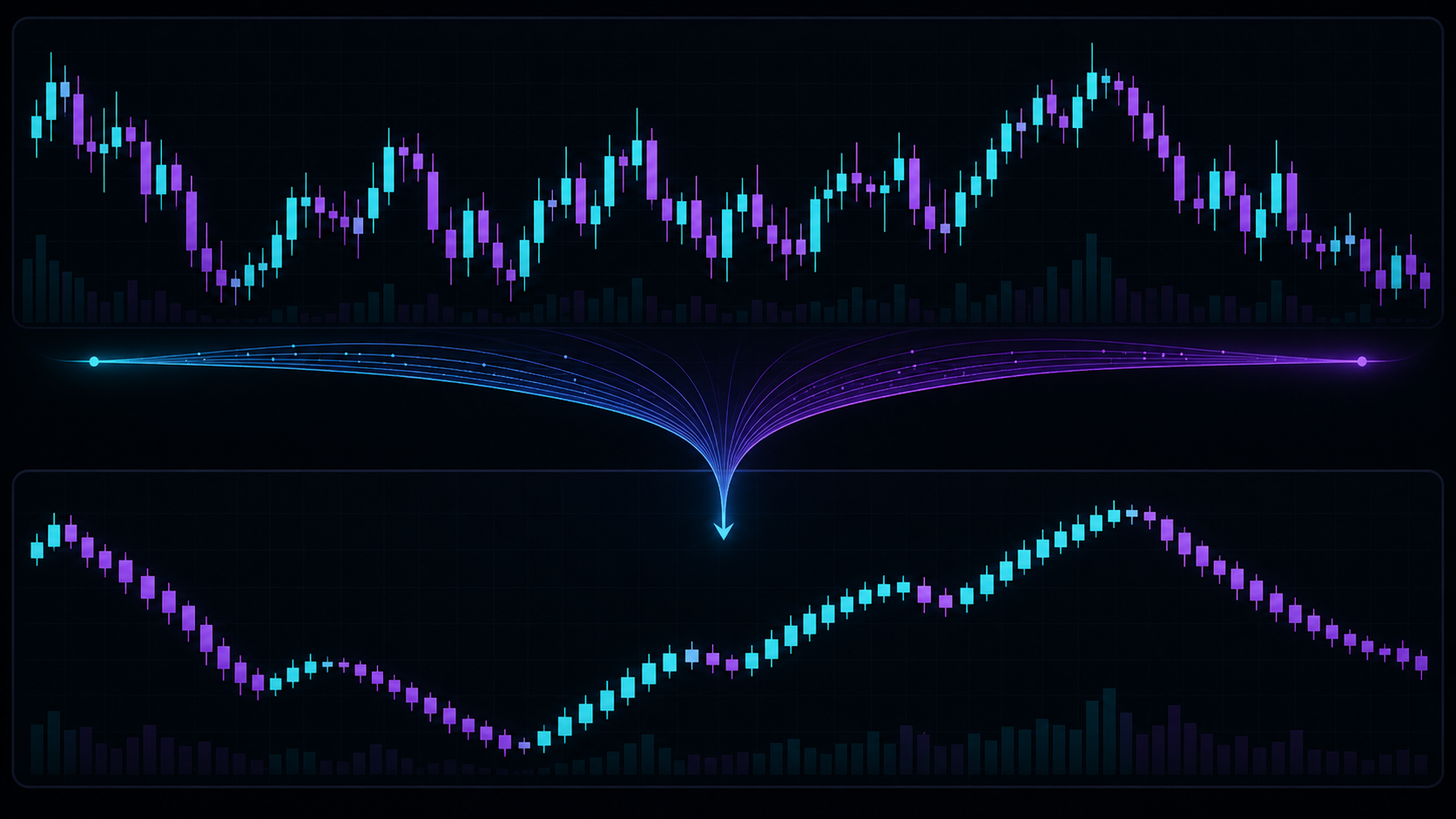
Use traditional candles when exact prices, gaps, and raw candle behavior matter. Use Heikin Ashi when you want a cleaner view of trend and momentum. Many traders use both for different stages of the same workflow.
The Core Difference
Traditional candles display actual traded open, high, low, and close values. Heikin Ashi candles use averaged values influenced by the previous HA candle.
| Question | Traditional candles | Heikin Ashi candles |
|---|---|---|
| Are displayed prices exact? | Yes | No, some values are synthetic |
| Is short-term noise preserved? | Yes | Reduced |
| Are gaps visible? | Yes | Often obscured |
| Is trend direction easy to scan? | Sometimes | Usually |
| Are classic candle patterns preserved? | Yes | Altered |
| Is execution from displayed prices appropriate? | Yes, subject to spread/slippage | No |
When Traditional Candles Are Better
Choose traditional candles when you need:
- exact highs, lows, opens, and closes;
- precise stop or order placement;
- gap analysis;
- raw rejection and wick behavior;
- classic candlestick pattern study;
- a direct view of market volatility.
Traditional candles contain more information, but that detail can tempt traders to react to every fluctuation.
When Heikin Ashi Is Better
Choose Heikin Ashi when you need:
- a quick directional overview;
- fewer distracting candle-color changes;
- consistent trend classification;
- a clearer view of momentum persistence;
- rules based on broader market state.
Heikin Ashi does not create a stronger trend. It makes existing directional behavior easier to perceive.
Use Both Without Creating Confusion
A practical two-layer workflow:
- Use Heikin Ashi on a context chart to classify trend and momentum.
- Use traditional candles or actual market prices for execution.
- Keep support, resistance, and invalidation consistent across both views.
- Do not switch candle types merely to justify a trade.
This separates the question “What condition is the market in?” from “At what actual price should I act?”
Why Results Can Look Surprisingly Different
Because HA candles depend partly on previous averaged values:
- color changes may occur later;
- candle bodies can look more orderly;
- raw price gaps may disappear;
- apparent opens may not have traded;
- quick reversals can be visually delayed.
The smoother chart is not more truthful or less truthful. It is a different representation designed for a different task.
Which Should a Beginner Use?
Learn traditional candles first. They teach actual price behavior and prevent confusion about execution.
After that, add Heikin Ashi as a context tool. The goal is not to choose a permanent winner; it is to know what information each view preserves and removes.
Key Takeaways
- Traditional candles preserve price precision and raw behavior.
- Heikin Ashi emphasizes directional clarity through averaging.
- HA values should not be used as exact execution prices.
- A context chart and an execution chart can use different candle types.
- Choose the representation that answers your current question.
Continue Learning
- Review how candlesticks work.
- Understand why ZenAlgo uses Heikin Ashi.
- Learn how timeframes change what each candle represents.
Changing chart representation does not improve a strategy by itself. Test rules with realistic tradable prices before risking capital.