Breakouts, Retests, and Failed Breakouts
A breakout occurs when price leaves an established range or important zone. The challenge is deciding whether the market accepts the new area or quickly rejects it.
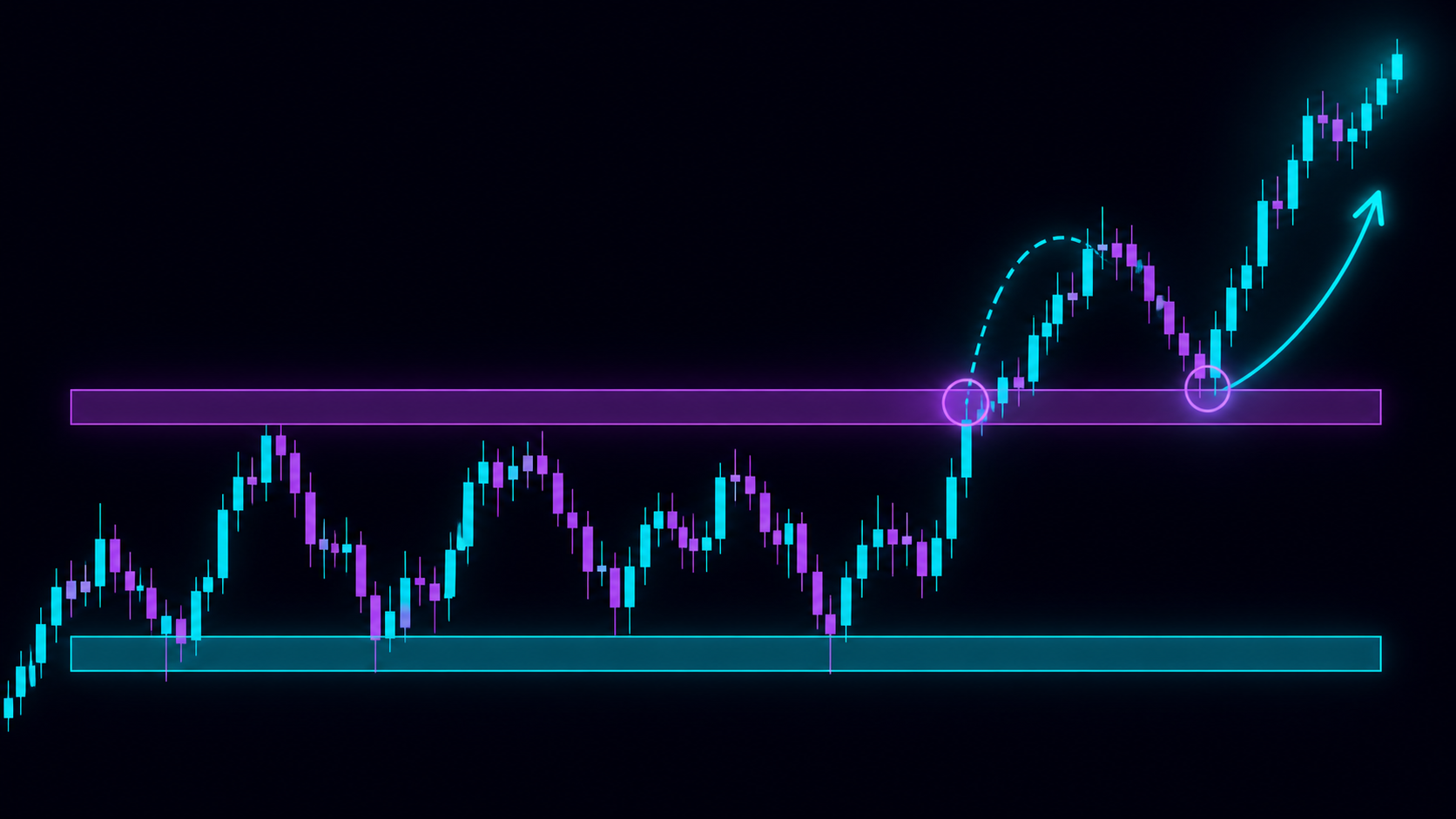
A quality breakout shows decisive movement beyond a meaningful boundary and continued acceptance outside it. A retest checks the broken area from the other side. A failed breakout returns to the prior range and traps traders who acted too early.
What Makes a Breakout Meaningful?
A breakout matters only if the boundary mattered first.
Look for:
- a clearly defined range or structural level;
- enough compression or repeated pressure before the move;
- decisive movement beyond the boundary;
- closes and time spent outside the old area;
- participation or volatility expansion;
- room before the next major obstacle.
An isolated wick beyond a random line is not a strong breakout.
Acceptance vs Rejection
Acceptance means price can remain and trade beyond the old boundary. Rejection means price quickly returns.
Signs of acceptance may include:
- multiple closes outside the range;
- a shallow pullback that holds the boundary;
- continued higher highs after an upside break;
- expanding activity without immediate reversal.
Signs of rejection may include:
- a long wick followed by a close back inside;
- immediate opposite momentum;
- failure to hold the first retest;
- a move through the opposite side of the range.
What Is a Retest?
After breaking resistance, price may return to test it as support. After breaking support, it may test it as resistance.
A retest can offer clearer invalidation than chasing the initial move. However, not every breakout retests, and not every retest holds.
Why Breakouts Fail
Common causes include:
- insufficient participation;
- breakout directly into higher-timeframe opposition;
- thin-liquidity spikes;
- stop runs beyond obvious boundaries;
- broader market disagreement;
- news volatility;
- a range that was poorly defined.
[Squeeze] context is useful for volatility compression and expansion. Sessions helps reveal when activity and liquidity may change. Avenger helps keep the broader trend visible.
Three Common Entry Approaches
| Approach | Advantage | Main risk |
|---|---|---|
| Enter on the break | Captures moves that never retest | Highest false-breakout exposure |
| Enter on the retest | Clearer location and invalidation | Move may continue without entry |
| Enter after retest confirmation | More evidence | Later entry and reduced reward-to-risk |
No approach is universally best. Test one consistent rule set.
A Breakout Checklist
- Is the boundary obvious?
- Is price compressing or building pressure?
- Does the breakout close beyond the zone?
- Is there space to the next obstacle?
- Does broader trend support it?
- What would prove the breakout failed?
- Is the planned reward worth the defined risk?
Key Takeaways
- Breakouts require meaningful boundaries.
- Acceptance outside the old area matters more than a brief wick.
- Retests can clarify location and invalidation.
- Failed breakouts often return quickly into the prior range.
- Do not chase a move without a predefined plan.
Continue Learning
- Compare range trading and trend trading.
- Learn pullbacks vs reversals.
- Explore Sessions for activity context.
Breakouts can reverse rapidly and create slippage. Define maximum risk before entry and never assume a retest must hold.