How to Read a Trading Chart
A trading chart shows how the price of one specific instrument changed over time. Reading it well begins with context, not prediction.
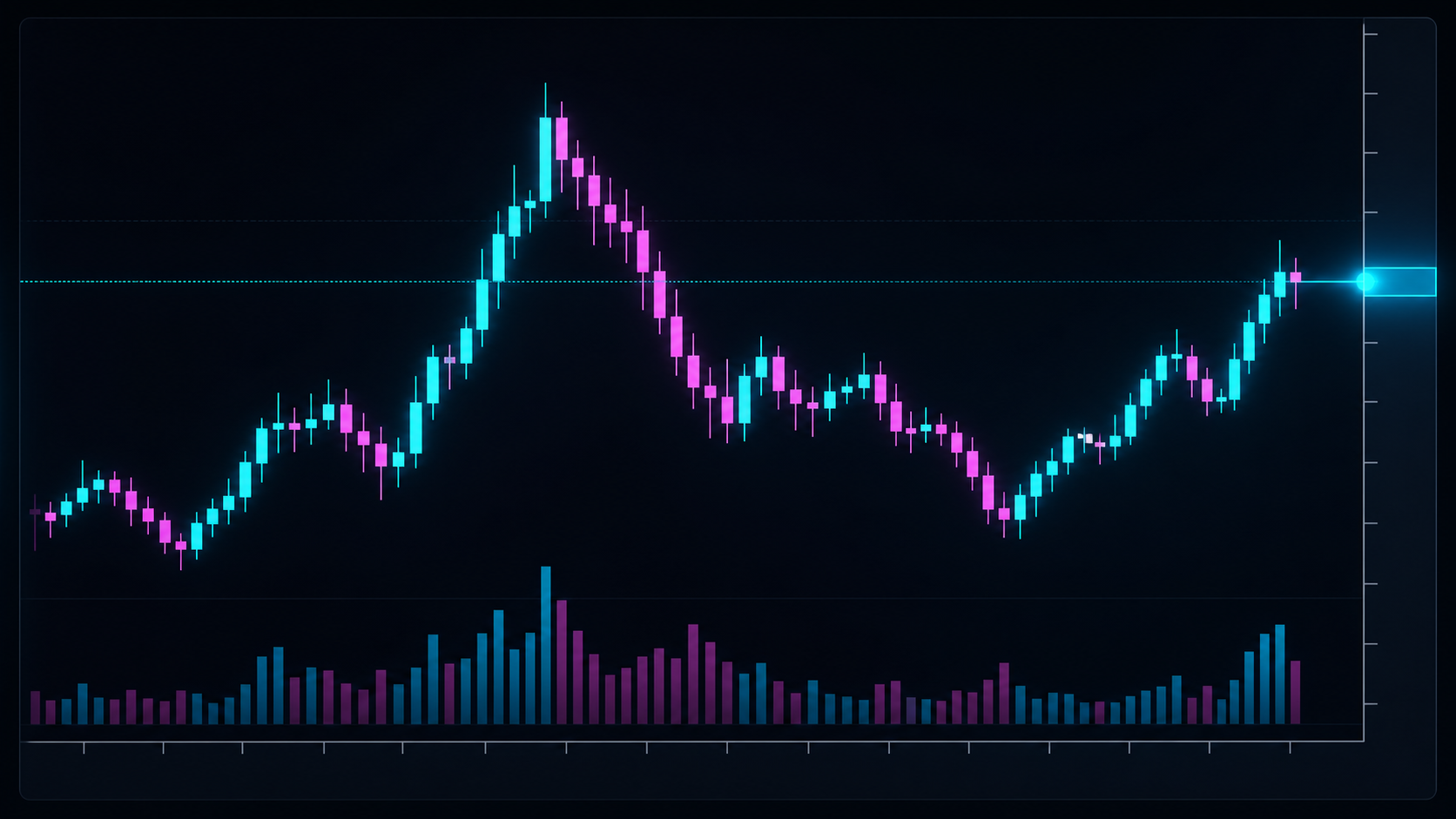
Read a chart from the outside in: confirm the instrument and timeframe, identify the broad condition, mark important areas, and only then inspect individual candles or signals.
When beginners open a chart, the first thing they often notice is movement. A candle jumps, a line crosses, a signal appears, and the mind immediately wants to know whether to buy or sell.
That is too fast.
A chart is not one candle. It is a story of price over time. Before you care about the latest signal, you need to know what market you are looking at, what timeframe it represents, whether price is trending or ranging, and where previous reactions happened. Without that context, even a clean signal can become a bad decision.
Start With the Simple Facts
First confirm the instrument. BTCUSD spot, a perpetual futures contract, and a broker CFD may look similar, but they can have different pricing, volume, funding, spread, and execution conditions. If you analyze one instrument and trade another, your chart may not match your risk.
Then confirm the timeframe. A five-minute candle and a daily candle compress very different amounts of information. A move that looks dramatic on a lower timeframe may be a small pullback on a higher timeframe.
Only after that should you study the candle itself.
Read the Broad Condition First
Zoom out enough to see the market's behavior. Is price making directional swings with controlled pullbacks? Is it rotating between boundaries? Is volatility compressing? Has price just broken from a range, or is it transitioning after a long trend?
This broad condition decides which questions matter. In a trend, you may look for pullbacks and continuation. In a range, you may care more about boundaries and failed breakouts. In compression, patience and alerts may matter more than immediate entries.
Avenger can help simplify trend and structure. Boxer and Ranger can help frame range and value conditions.
Mark Areas, Not Perfect Prices
Support and resistance are usually zones where behavior changed, not exact one-pixel lines. Price may react slightly above or below the level because real markets have spread, liquidity, stops, and different participants acting at once.
Mark major swing highs and lows, range boundaries, breakout and retest zones, and frequently revisited value areas. Levels can help create objective reference areas based on VWAP and deviations.
The purpose of marking levels is not to predict a guaranteed reaction. It is to know where a reaction would matter.
Then Look at Candles and Volume
A single candle becomes meaningful only after location and context are clear.
A large bearish candle in a healthy uptrend may be a pullback. A small bullish candle after a major breakdown may be noise. A breakout candle near a clean level means more than the same candle in the middle of a messy range.
Volume adds another layer. It shows activity, not certainty. A breakout with strong participation deserves different attention than a breakout that drifts higher on weak activity. For deeper participation context, explore Ultimate, Heavy Delta, and the Volume, Order Flow, and Value section.
A Repeatable Reading Flow
Before considering a trade, try to describe the chart in one sentence:
"Price is in a higher-timeframe uptrend, pulling back toward previous resistance that may act as support."
That sentence is useful because it forces context, location, and idea into one thought. If you cannot describe the chart simply, the setup may not be ready.
Then ask where the idea is wrong, what would confirm it, whether there is enough space before the next obstacle, and whether the planned risk fits your rules. This connects chart reading directly to risk management and later to planning an entry, stop, and targets.
Common Beginner Mistakes
The most common mistake is reading indicators before reading price. Another is changing timeframe until the chart tells the story you want. A third is zooming in so far that normal noise looks like structure.
Good chart reading is slower. It starts wide, narrows carefully, and accepts that waiting is often the best decision.
Continue Learning
- Learn how candlesticks work.
- Understand market structure.
- Compare range trading with trend trading.
- Practice the full top-down chart analysis workflow.
Technical analysis cannot predict markets with certainty. Always define risk and invalidation before entering a trade.