Spot vs Futures Trading
Spot and futures markets can track the same asset while giving traders very different rights, obligations, and risks.
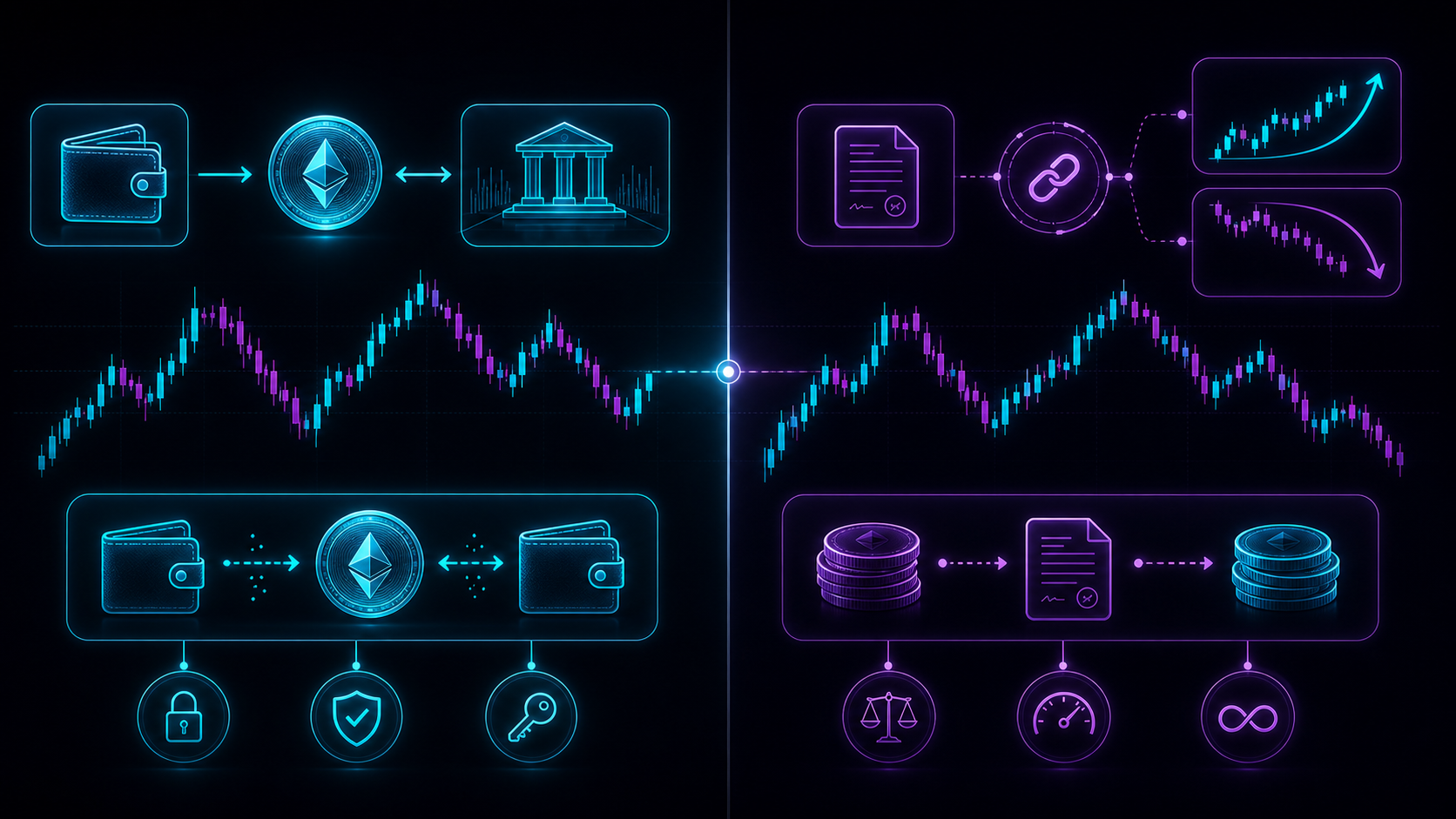
Spot trading exchanges one asset for another and usually creates direct ownership. Futures trading creates price exposure through a contract. Futures make shorting and leverage accessible, but add margin, liquidation, funding, expiry, and contract-specific risks.
What Is Spot Trading?
In a spot market, settlement occurs immediately or according to the venue's standard settlement process.
When you buy an asset on spot:
- you generally own the purchased asset;
- there is usually no liquidation from price movement alone;
- an unleveraged long position can lose most or all of its value, but it cannot be forced closed merely because price declined;
- shorting may require borrowing or may not be available.
Ownership still carries custody, venue, and asset risk.
What Is Futures Trading?
A futures contract derives its value from an underlying market. You trade the contract rather than directly exchanging the underlying asset.
Futures can offer:
- straightforward long and short exposure;
- leverage and margin efficiency;
- hedging;
- standardized contract terms;
- access to markets without holding the underlying asset.
They can also introduce liquidation, funding or carry costs, expiry, basis risk, and complex exchange rules.
Compare the Products
| Feature | Spot | Futures or perpetuals |
|---|---|---|
| Direct ownership | Usually yes | No |
| Shorting | Limited or requires borrowing | Usually built in |
| Leverage | Sometimes available through margin | Common |
| Liquidation risk | Not for unleveraged spot | Yes when leveraged |
| Funding payments | No | Common for perpetuals |
| Expiry | No | Some futures expire |
| Open interest data | No contract OI | Often available |
Exposure Is Not Ownership
Owning one unit of an asset and holding a futures position with equivalent notional exposure may produce similar short-term PnL, but they are not the same position.
The futures trader may face:
- margin requirements;
- forced liquidation;
- funding payments;
- contract settlement rules;
- price differences between contract and spot.
Always identify the exact symbol and contract before analyzing or trading.
Why Futures Can Be Useful
Futures are useful for:
- hedging spot holdings;
- expressing a bearish view;
- managing capital efficiently;
- trading markets where direct ownership is inconvenient;
- analyzing derivatives positioning through open interest.
Advanced Open Interest helps distinguish new futures positioning from position closure. Delta adds participation context.
Which Is Better for Beginners?
Unleveraged spot is usually easier to understand because it removes liquidation and funding mechanics. Futures should be considered only after the trader can calculate:
- notional exposure;
- stop distance;
- maximum account risk;
- margin requirements;
- liquidation risk;
- ongoing costs.
The product should serve the strategy. Easy access to leverage is not a reason to use it.
Common Misunderstandings
- “Futures are only for gambling.” They are also used professionally for hedging and efficient exposure.
- “Spot cannot lose everything.” An asset can still collapse in value or become inaccessible.
- “The spot and futures charts are identical.” Temporary differences can occur.
- “Using less margin means risking less.” Risk depends on position size and exit, not margin alone.
Key Takeaways
- Spot usually represents ownership; futures represent contractual exposure.
- Futures make shorting and leverage easier but add new risks.
- Equivalent notional exposure does not mean equivalent product risk.
- Beginners should understand spot before using leveraged derivatives.
Continue Learning
- Learn how spot and futures affect each other.
- Understand perpetual futures and funding.
- Review what leverage changes.
Futures and leveraged products can produce losses beyond the margin initially allocated, depending on venue rules and market conditions.