How Spot and Futures Markets Affect Each Other
Spot and futures markets are separate venues connected by participants who trade price differences, hedge exposure, and react to the same information.
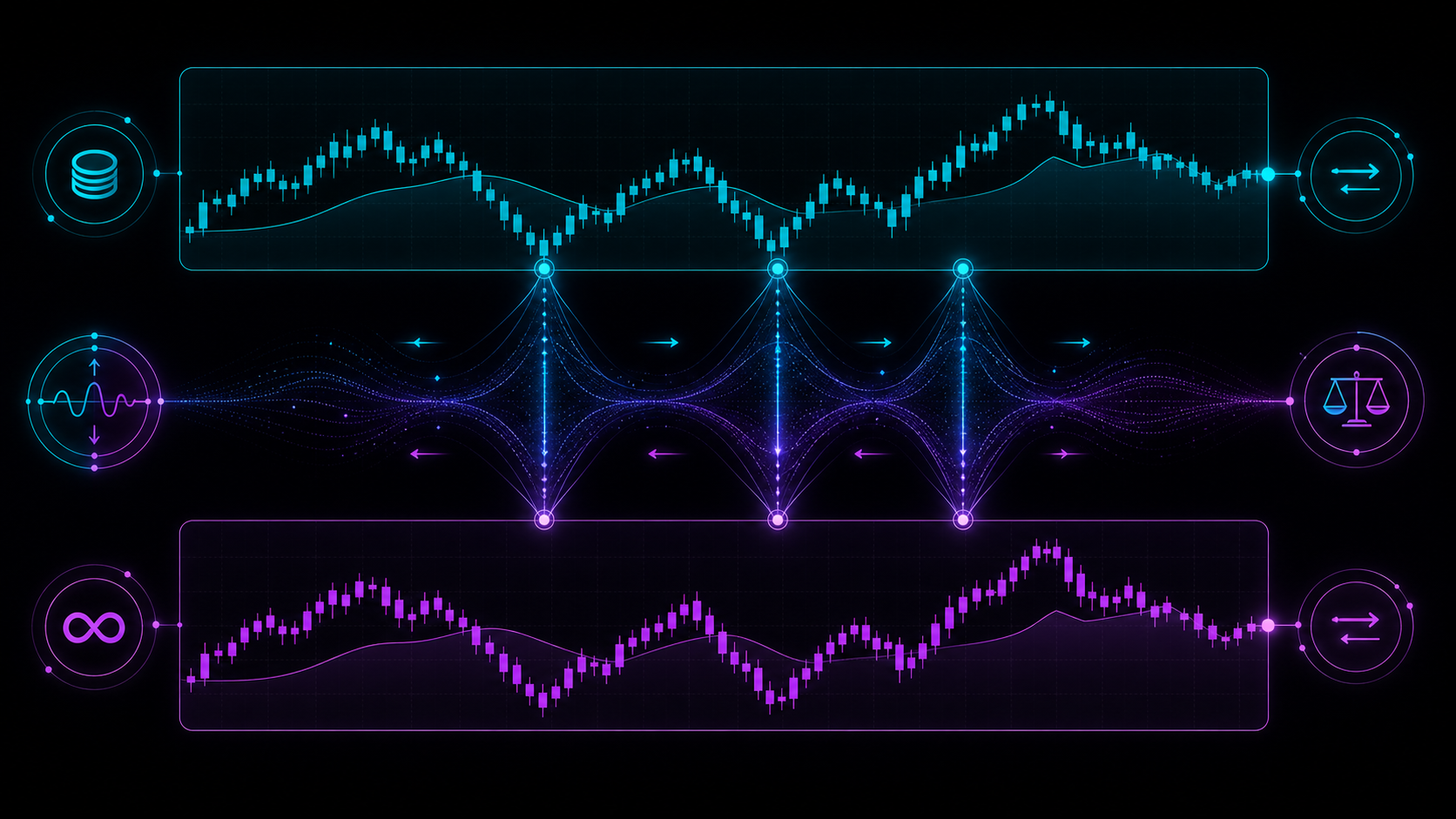
Arbitrage and hedging usually keep spot and futures prices closely linked. Futures can temporarily lead during leveraged speculation, while spot buying or selling can provide stronger evidence of direct demand. Neither market should be interpreted in isolation.
Why Prices Stay Connected
If a futures contract becomes expensive relative to spot, traders may sell the contract and buy spot. If it becomes cheap, they may buy the contract and sell or hedge spot.
These actions tend to reduce the difference.
The price difference is commonly called the basis:
- futures above spot: positive basis;
- futures below spot: negative basis;
- basis narrowing: prices converging.
Costs, risk, funding, borrowing, and execution prevent perfect alignment.
Which Market Leads?
Leadership can change.
Spot may lead when:
- direct buying or selling is strong;
- long-term participants are accumulating or distributing;
- derivatives positioning is relatively quiet.
Futures may lead when:
- leverage and speculation increase rapidly;
- news causes immediate derivative activity;
- liquidations accelerate movement;
- short-term traders dominate price discovery.
The useful question is not “Which always leads?” but “Where is current participation coming from?”
Spot-Driven vs Derivatives-Driven Moves
| Observation | Possible interpretation |
|---|---|
| Price rises with strong spot participation | Direct demand supports the move |
| Price rises mainly through perpetual buying | Leverage may be driving the move |
| Price rises while open interest falls | Short covering may be contributing |
| Price falls while open interest rises | New short exposure may be entering |
| Futures diverge sharply from spot | Temporary stress or positioning imbalance |
These are context clues, not automatic trade signals.
Bender compares spot and perpetual participation. Detector compares total and perpetual-market activity. Advanced Open Interest helps explain whether positions are entering or closing.
How Liquidations Affect Both Markets
Leveraged futures positions can be forcibly closed. A wave of long liquidations creates market selling in derivatives; short liquidations create market buying.
The resulting futures movement can influence spot through:
- arbitrage;
- trader reactions;
- shared liquidity providers;
- stop orders and risk reduction;
- changes in sentiment.
Liquidation-driven moves can be fast and unstable.
Use the Same Instrument for Analysis and Execution
A spot chart, dated futures contract, and perpetual contract may show different:
- highs and lows;
- volume;
- wicks;
- gaps;
- funding or basis;
- liquidity.
Analyze the contract you plan to trade, then use related markets as context.
A Practical Reading Workflow
- Identify whether your chart is spot, futures, or perpetual.
- Compare the direction and strength of related markets.
- Check whether open interest is rising or falling.
- Observe whether spot and perpetual participation agree.
- Treat disagreement as a reason to investigate, not an automatic reversal.
Key Takeaways
- Spot and futures are separate but linked markets.
- Arbitrage usually keeps their prices close.
- Leadership changes with participation and market conditions.
- Open interest and spot/perpetual flow help explain a move.
- Liquidations can transmit derivatives stress into the wider market.
Continue Learning
- Understand perpetual funding rates.
- Learn margin and liquidation.
- Explore Bender and Advanced Open Interest.
Related-market relationships can break temporarily during stress. Arbitrage and market context do not eliminate execution or liquidation risk.