Isolated Margin vs Cross Margin
Margin mode determines which collateral can support a leveraged position and how losses can spread across an account.
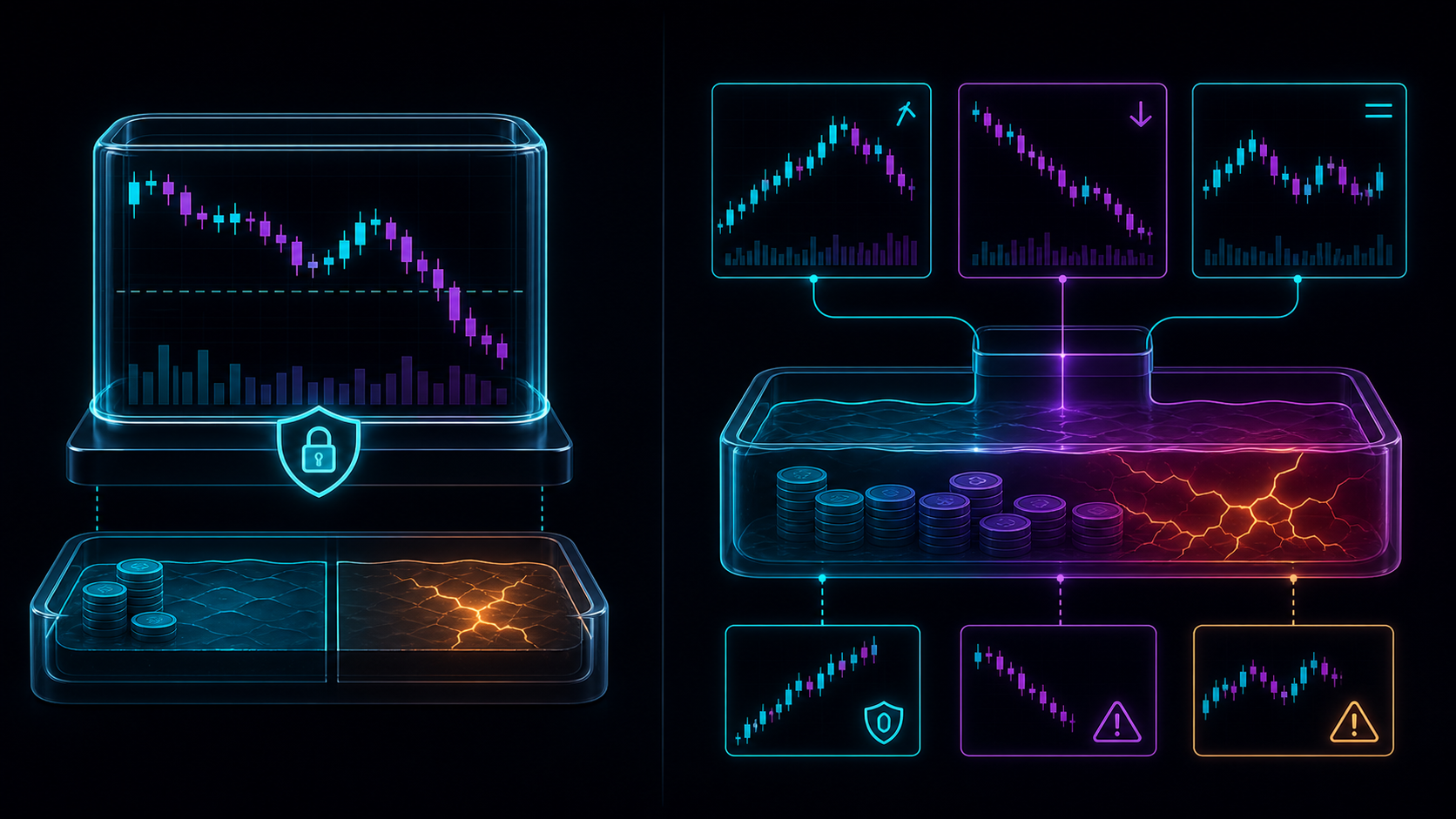
Isolated margin confines the position to specifically allocated collateral. Cross margin can use a broader shared balance to support positions, reducing immediate liquidation risk while exposing more of the account.
How Isolated Margin Works
Under isolated margin, collateral is assigned to one position or position group.
Potential advantages:
- clearer maximum collateral allocation;
- one losing position is less likely to consume the full shared balance;
- easier separation of independent trade ideas.
Potential disadvantages:
- liquidation may occur sooner;
- unused account balance cannot automatically support the position;
- active management may be required.
Exact loss behavior still depends on the venue.
How Cross Margin Works
Cross margin shares eligible account collateral across positions.
Potential advantages:
- a larger buffer against liquidation;
- gains and collateral elsewhere may support a position;
- useful for coordinated hedges or portfolio management.
Potential disadvantages:
- one position can consume much more account equity;
- losses can spread across several positions;
- account-level risk becomes harder to understand;
- correlated trades can fail together.
Cross margin postpones liquidation by making more collateral available. It does not reduce the underlying market loss.
Compare the Modes
| Question | Isolated margin | Cross margin |
|---|---|---|
| Collateral scope | Assigned position collateral | Shared eligible balance |
| Loss containment | Usually clearer | Losses can affect more of account |
| Liquidation buffer | Smaller unless margin added | Can use broader balance |
| Best suited for | Independent, bounded ideas | Coordinated portfolio or hedging use |
| Beginner clarity | Usually easier | Usually harder |
Why Cross Margin Can Feel Safer Than It Is
A distant liquidation price can create false comfort. If the position remains open because the whole account supports it, the trader may lose far more than originally intended.
The correct measure is not only liquidation distance. It is:
- total account exposure;
- combined stop-loss risk;
- correlation between positions;
- worst-case execution;
- the amount of collateral accessible to the system.
A Practical Choice Framework
Consider isolated margin when:
- the trade should have a clearly bounded collateral allocation;
- positions are independent;
- you are learning leveraged execution.
Consider cross margin only when:
- you understand account-level exposure;
- positions intentionally hedge or interact;
- shared collateral is part of a tested plan;
- you monitor total risk continuously.
Common Mistakes
- Assuming isolated margin guarantees losses cannot exceed allocation.
- Using cross margin to avoid accepting a stop loss.
- Opening several correlated positions without aggregating risk.
- Focusing on liquidation price instead of planned account loss.
- Changing margin mode without understanding venue behavior.
Key Takeaways
- Isolated margin limits the collateral assigned to a position.
- Cross margin shares eligible collateral across positions.
- Cross margin can delay liquidation while exposing more account equity.
- Margin mode does not replace stop loss and position sizing rules.
- Beginners usually find isolated risk easier to understand.
Continue Learning
- Review margin and liquidation.
- Learn long and short position mechanics.
- Understand trading costs.
Margin-mode protections depend on venue rules. Confirm whether losses, fees, or deficits can affect other balances before trading.