What Is a Trading Strategy?
A trading strategy is a written set of rules for when to trade, when not to trade, how much to risk, where the idea is wrong, and how results will be reviewed.
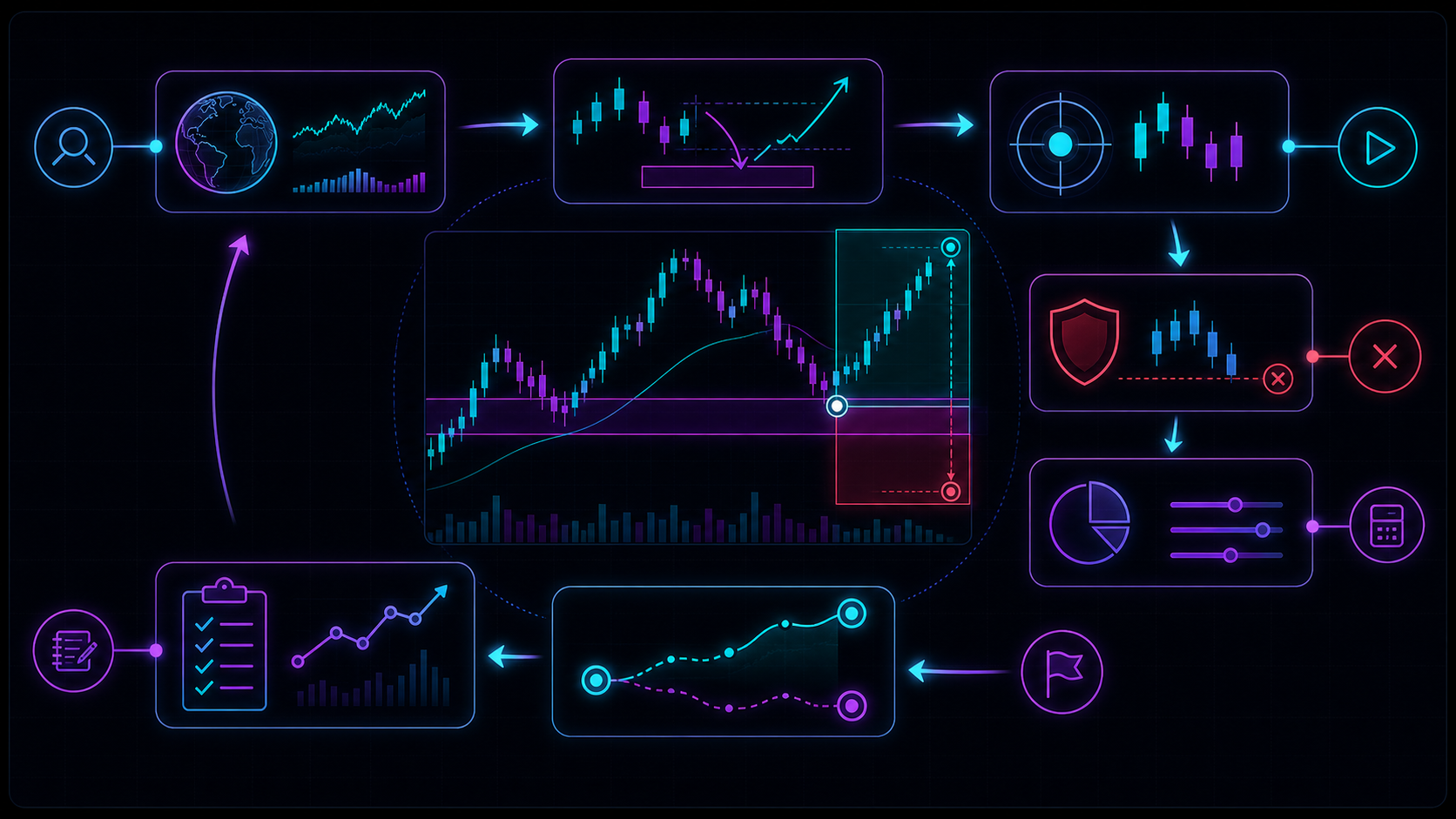
An indicator gives information. A signal attracts attention. A strategy defines what to do, when to do it, and when to do nothing.
What a Strategy Must Define
A complete strategy defines:
- market and timeframe;
- market conditions it trades;
- setup requirements;
- entry trigger;
- invalidation;
- stop placement;
- position sizing;
- target or exit logic;
- trade management;
- review process.
If those pieces are not defined, the trader is usually improvising.
Strategy vs Setup vs Signal
A signal is one event, such as a divergence label, a cross, or a breakout candle.
A setup is a specific opportunity pattern.
A strategy is the complete process around the setup: when it is allowed, how it is executed, and how it is judged over many trades.
Process Comes Before PnL
Short-term PnL is noisy. A strategy can lose several correct trades in a row. A trader can also make money while breaking rules.
That is why process quality must be measured separately.
A well-executed losing trade can be a successful strategy execution. A profitable rule violation can be a warning sign.
Using ZenAlgo
ZenAlgo indicators can help define strategy roles. Avenger can define trend and value context, Waves can support momentum confirmation, Delta can show participation, and Grid or ABC can help plan structure and targets.
The strategy is the rulebook that tells you when those tools matter.
Continue Learning
- Build a strategy step by step.
- Learn signal vs setup.
- Review risk management.
A written strategy does not guarantee profitability. It creates a consistent process so results can be measured and improved.