Trading for Beginners: Where to Start
Trading can look impossibly complicated at first.
A chart is moving every second. Experienced traders use unfamiliar words. Social media shows dramatic wins, dozens of indicators, and confident predictions that contradict each other. It is easy to feel that everyone else understands something you do not.
The good news is that you do not need to learn everything before you can make progress. You need to learn the right things in the right order.
This guide gives you that order.

Start by learning how markets, charts, and orders work. Then learn risk management. Only after that should you study setups, indicators, and strategies. Practice with paper trading or very small risk until you can follow a written process consistently.
What Trading Actually Is
Trading is taking a position in a market because you believe price may move in a particular direction. A long position benefits if price rises. A short position benefits if price falls. A spot trade exchanges one asset for another. A futures trade uses a contract linked to an asset's price.
That description is simple. Good trading is not.
The reason is uncertainty. A trader never knows with certainty what the next candle will do. The real job is to identify a situation where one outcome appears more likely than another, define where the idea becomes invalid, limit the amount that can be lost, execute the same process repeatedly, and review the results over many trades.
Trading is therefore not a prediction contest. It is decision-making under uncertainty.
Your First Goal Is Not Profit
Most beginners begin with the wrong target: make money as quickly as possible.
A better first target is more boring and much more useful:
Learn to make planned decisions while keeping losses small enough to continue learning.
Early profits can be misleading. A poorly planned trade can win through luck, while a well-planned trade can lose even when the decision was reasonable. If you judge every decision only by its immediate profit or loss, luck can teach you dangerous habits.
At the beginning, progress looks like waiting for your planned setup, knowing your maximum loss before entry, placing the stop where the idea becomes invalid, avoiding emotional changes, and recording the trade honestly. Profit matters over time, but process comes first.
The Five Skills Every Trader Needs
Trading becomes easier to understand when you divide it into five skills.
Market knowledge tells you what you are trading and how that market works. Chart reading tells you what price is doing. Setup selection defines when you are willing to participate. Risk management decides how much damage one wrong idea can cause. Review and psychology determine whether you can follow and improve the process consistently.
A weakness in any one of these areas can damage the entire system. Excellent analysis cannot rescue uncontrolled risk. Good risk management cannot turn random entries into a complete strategy. A powerful indicator cannot help if the trader changes rules after every loss.
Learn the Market Before the Setup
Before opening a position, understand what you are buying or selling.
Crypto, stocks, forex, and futures share many chart concepts, but they do not behave identically. They differ in trading hours, liquidity, fees, spread, leverage, liquidation risk, and data quality. Choose one market to study first so you can recognize its normal behavior.
This is where How Financial Markets Work, How to Choose a Market to Trade, and Markets, Orders, and Leverage become important. A trader who does not understand the product can be right about direction and still manage the trade badly.
Learn to Read the Chart
A chart is a record of how price changed over time. It is not a crystal ball.
Start with candles, timeframes, trend, market structure, and areas of interest. Learn to recognize whether price is trending, ranging, breaking out, or transitioning. Learn where price has reacted before. Learn why the same candle can mean different things in different locations.
At this stage, resist the urge to memorize dozens of candlestick patterns. First learn to see the broader condition of the market. How to Read a Trading Chart and Market Structure are better foundations than pattern hunting.
If you cannot explain what each item on your chart helps you decide, remove it. More information is not automatically better information.
Define One Setup
A setup is a repeatable set of market conditions that tells you when a trade is worth considering.
For example, a basic trend-following setup might require a clear trend, a pullback into a planned area, evidence that the area is holding, enough space before the next obstacle, and a logical invalidation point. Notice that this is more than a green dot, an indicator crossover, or a candle pattern.
A signal is one piece of information. A setup combines context, location, confirmation, and risk.
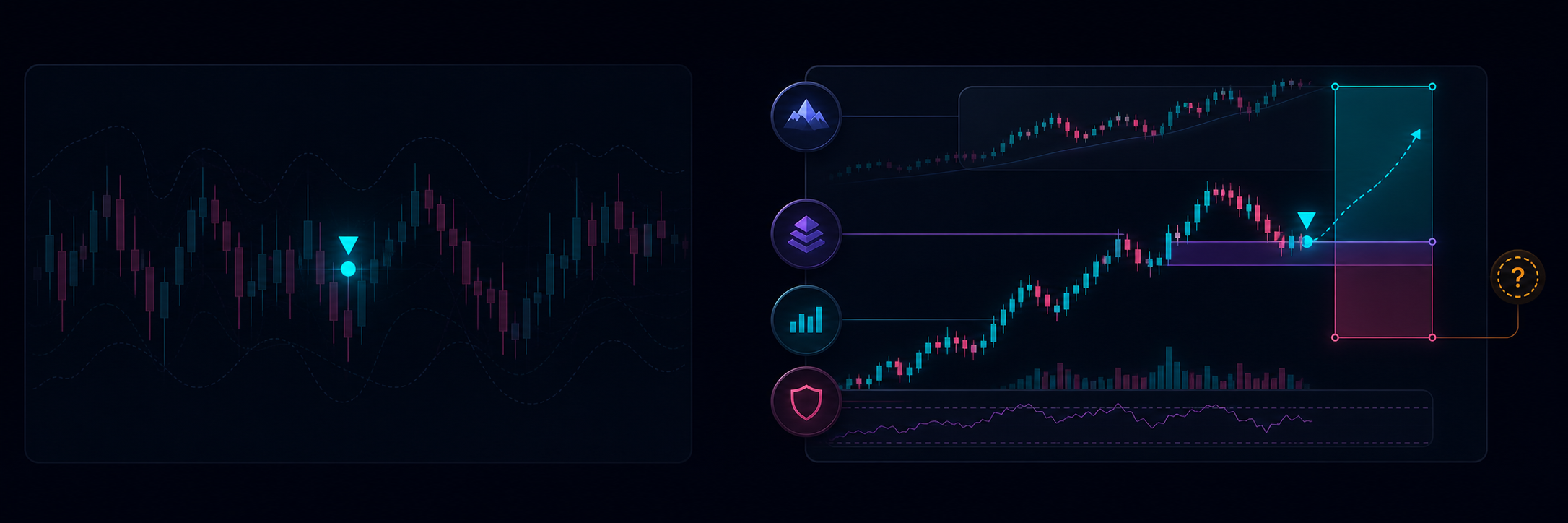
ZenAlgo tools are designed around this idea. Avenger can make trend context and reaction areas easier to read, while Levels can identify objective areas of interest. Neither tool removes uncertainty or replaces a trading plan.
Protect Your Capital
Risk management is the skill that keeps one bad decision from becoming a disaster.
Before every trade, know where you will exit if the idea is wrong, how much that exit would lose, whether the possible reward justifies the risk, and whether fees, slippage, leverage, or liquidation materially change the outcome.
Suppose you have a $1,000 account and decide to risk 1% on a trade. Your maximum planned loss is $10. That $10 risk, not your confidence or excitement, determines the appropriate position size.
Leverage changes how much exposure and liquidation risk you carry. It does not make your analysis more accurate. Beginners should understand position sizing, margin, and liquidation before using leverage.
No risk rule guarantees survival, especially during gaps, extreme volatility, or platform failure. Its purpose is to keep normal losses controlled and survivable. Start with Risk Management for Traders before thinking about advanced entries.
Review Your Decisions
Improvement requires evidence.
Keep a simple journal with screenshots, setup type, market condition, entry, stop, target, planned risk, rule adherence, result in R, and one lesson. Review groups of trades, not isolated outcomes. A strategy cannot be judged fairly from three wins or three losses.
This is where many beginners skip too far ahead. They want a better signal, but the real issue may be overtrading, poor risk, chasing, or changing the strategy every few days. Trading Psychology and Performance and Journaling and Metrics exist because those problems decide whether knowledge becomes consistent behavior.
A Simple Decision Process
Before considering a trade, answer these questions in order:
- What is the market condition?
- Where is price?
- Does my setup exist?
- Where is the idea invalid?
- How much am I risking?
- Where could I exit profitably?
- What would make me skip the trade?
If you cannot answer one of these questions, waiting is a valid decision.
Common Beginner Mistakes
The biggest mistake is trading with money you cannot afford to lose. Financial pressure makes disciplined decisions much harder.
Another common mistake is using leverage before understanding risk. High leverage can turn a small price movement into liquidation. Learn the relationship between position size, margin, stop distance, and account risk first.
Beginners also change strategies too quickly. Every strategy has losing trades. Constantly changing rules prevents you from collecting enough consistent evidence to know whether a strategy has merit.
Finally, many beginners add indicators to remove uncertainty. No collection of tools can make a trade certain. Use each indicator to answer a specific decision question: trend, location, momentum, participation, readiness, or risk structure.
What Good Progress Looks Like
Progress in trading is often quiet.
It may look like taking fewer trades, skipping unclear conditions, accepting a small loss without revenge trading, following a stop even when price later reverses, recording a mistake honestly, or ending a profitable day because no further setup exists.
A losing trade that followed every rule can be a successful execution. A winning trade that broke every rule can be a warning.
Your First Seven Days
Use the first week to build a foundation without rushing into real-money decisions.
| Day | Focus | Practical task |
|---|---|---|
| 1 | Market mechanics | Choose one market and learn how its spot or futures product works. |
| 2 | Chart basics | Identify candles, timeframes, trends, and ranges on ten charts. |
| 3 | Areas of interest | Mark previous highs, lows, and obvious reaction zones. |
| 4 | Risk | Practice calculating maximum loss and position size. |
| 5 | One setup | Write a simple checklist for one setup. |
| 6 | Simulation | Find historical examples that qualify and examples that do not. |
| 7 | Review | Simplify your checklist and write down your recurring questions. |
For a more product-focused version, follow Your First Seven Days With ZenAlgo.
Continue Learning
- Use Essential Trading Terms when you encounter unfamiliar terminology.
- Learn Heikin Ashi Candles Explained to understand smoother trend context and its limitations.
- Explore Avenger for a calm, trend-first approach.
- Review ZenAlgo indicator documentation when you need to understand a specific tool.
Practice With ZenAlgo
The complete ZenAlgo toolkit can help you practice reading trend, market structure, momentum, and order flow within one TradingView workflow.
Use the trial as a learning period: keep your chart simple, choose one setup, and record what each tool helps you decide.
7 days free. No credit card required.
This article is for educational purposes only and is not financial advice. Trading involves substantial risk, and you can lose some or all of your capital. No indicator, setup, or strategy guarantees a profit.