How Financial Markets Work
Every market chart is the visible result of thousands or millions of decisions.
Some participants need to buy. Others need to sell. An exchange brings their orders together, and price changes whenever the balance between available buyers and sellers changes.

A financial market connects buyers and sellers. Orders compete for available liquidity, trades occur when prices match, and the latest completed trades form the price shown on a chart.
The Market Is an Auction
The simplest useful model of a market is a continuous auction.
- Buyers state what they are willing to pay.
- Sellers state what they are willing to accept.
- The exchange matches compatible orders.
- Completed trades become market data.
- The chart summarizes how that price changed over time.
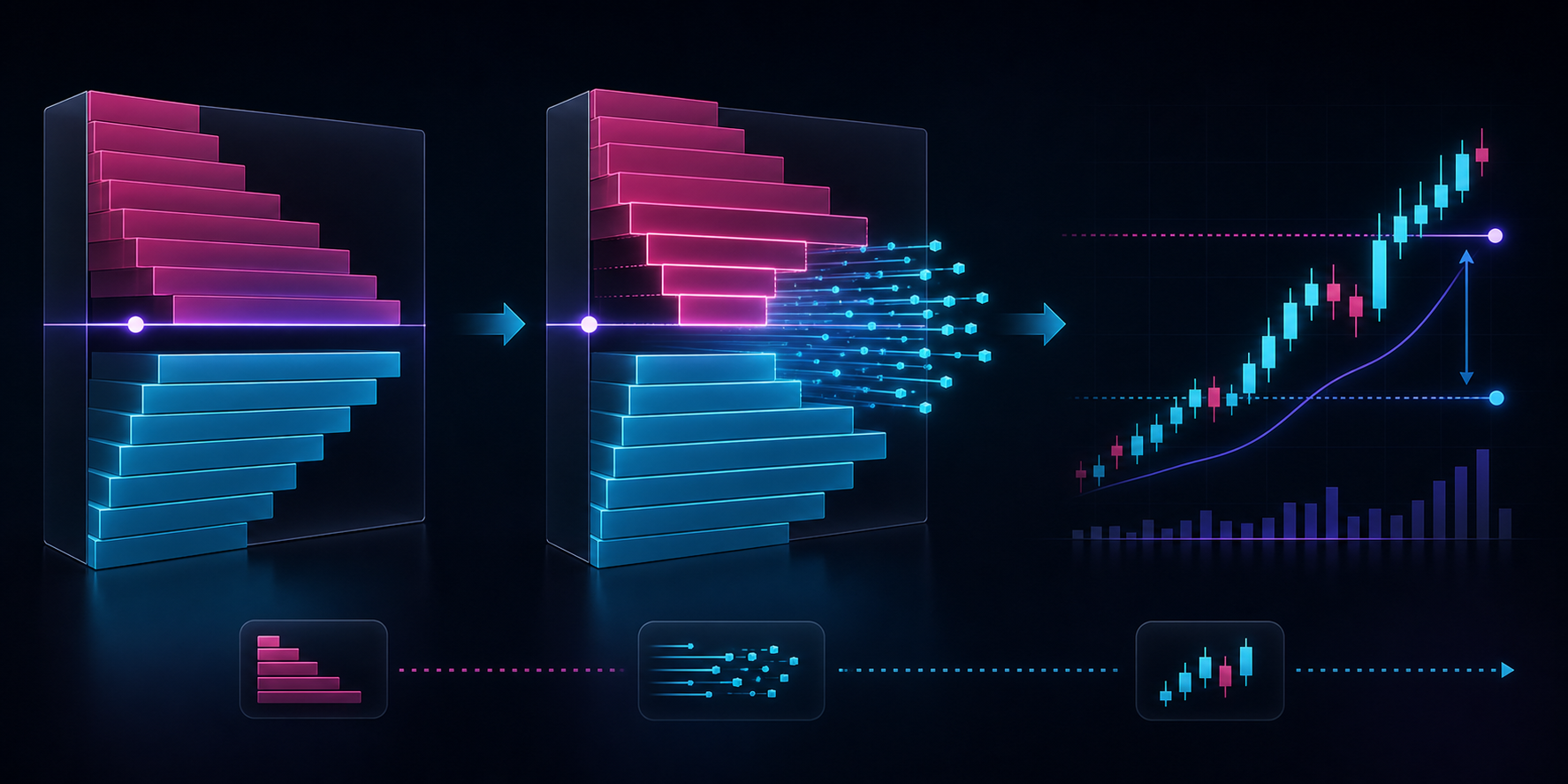
If aggressive buyers consume the available sell orders near the current price, they must pay progressively higher prices. Price rises. If aggressive sellers consume available buy orders, price falls.
This does not mean every rising candle contains only buyers. Every completed trade has both a buyer and a seller. What changes is which side is more urgent and how much liquidity is available.
The Main Participants
Markets contain participants with very different goals.
| Participant | Typical reason for trading |
|---|---|
| Investors | Build long-term exposure to an asset or market |
| Short-term traders | Seek profit from shorter price movements |
| Hedgers | Reduce risk elsewhere in a business or portfolio |
| Market makers | Continuously quote buy and sell prices |
| Institutions | Execute large investment, hedging, or allocation decisions |
| Arbitrageurs | Trade price differences between related markets |
You usually cannot know exactly who caused a move from a chart alone. Instead, study the evidence they leave behind: price, volume, delta, open interest, liquidity, and volatility.
Exchanges, Brokers, and Data Feeds
These terms are related but not interchangeable.
Exchange
An exchange is a venue where orders are matched. Different exchanges can show slightly different prices because each has its own participants and liquidity.
Broker
A broker provides access to markets and handles your orders. Depending on the product, the broker may route orders to an exchange, provide its own pricing, or work with other liquidity providers.
Data Feed
A data feed supplies prices, volume, and other market information to your charting platform. The chart you analyze is only as useful as the data behind it.
When possible, analyze the same instrument and data source you plan to trade. A futures chart, spot chart, and broker-provided contract can behave differently even when they reference the same underlying asset.
How Orders Become Price
Two basic order types explain much of short-term price behavior.
Limit Orders Provide Liquidity
A limit order waits at a specified price.
- A buy limit waits below or at a chosen price.
- A sell limit waits above or at a chosen price.
- It may never execute if price does not reach it.
Limit orders create much of the visible order book liquidity.
Market Orders Consume Liquidity
A market order prioritizes immediate execution at the best available prices.
Large or urgent market orders may execute across several price levels. This difference between the expected and actual execution price is called slippage.
Price moves when aggressive orders consume the liquidity available at the current level and must reach for the next one.
Bid, Ask, and Spread
The bid is the highest currently available buy price. The ask is the lowest currently available sell price.
The gap between them is the spread.
| Condition | Typical effect |
|---|---|
| Deep liquidity and active trading | Tighter spread and easier execution |
| Thin liquidity or market stress | Wider spread and more slippage |
| Large order relative to liquidity | Execution across multiple price levels |
Spread and slippage are trading costs. A setup can look profitable on a chart but perform poorly after realistic execution costs.
What Makes Price Move?
Price changes when market participants reassess value or urgency.
Common drivers include:
- new information and economic data;
- company earnings or project developments;
- changes in interest rates or broader risk appetite;
- large orders and forced liquidations;
- movement in related markets;
- changing expectations;
- temporary imbalances in liquidity.
The same news can produce different reactions depending on what the market already expected. This is why traders study the reaction, not only the headline.
Why Markets Trend, Range, and Break Out
Markets do not behave the same way all the time.
Trending
One side repeatedly accepts worse prices to maintain exposure. Pullbacks are absorbed and price continues in one direction.
Ranging
Buyers and sellers broadly agree on value. Price rotates between boundaries until new pressure appears.
Breaking Out
Price leaves an accepted area because liquidity is consumed or participants rapidly reassess value. Some breakouts continue; others fail and return to the prior range.
Avenger helps simplify trend context, while Sessions shows how activity and ranges develop across global trading periods.
Related Markets Influence Each Other
No market exists in isolation.
Examples:
- A stock may react to its sector and the wider index.
- A currency pair reflects the relative strength of two currencies.
- Crypto assets may react to Bitcoin, stablecoin flows, and broader risk appetite.
- Spot and futures markets influence each other through arbitrage.
ZenAlgo Crypto Trend provides a broad crypto market view, and Dominator helps compare relative strength across assets.
A Practical Way to Read Market Activity
When looking at a chart, ask:
- Where is price trading? Near accepted value, a previous extreme, or a breakout area?
- Is activity increasing? Is volume expanding or fading?
- Which side appears urgent? Are buyers lifting offers or sellers hitting bids?
- Is price progressing? Strong pressure without price progress can indicate absorption.
- What related markets are doing? Does the broader environment support the move?
You do not need a perfect explanation for every candle. The goal is to understand enough context to avoid treating all price movements as equal.
Common Misunderstandings
"More Buyers Than Sellers Made Price Rise"
Every completed trade has both sides. Price rises because buyers are more aggressive relative to available sell liquidity.
"The Chart Shows the Whole Market"
A chart shows a specific instrument from a specific data source. Another exchange or related contract may differ.
"Large Volume Guarantees Continuation"
High volume means high activity, not guaranteed direction. It can appear during continuation, absorption, panic, or exhaustion.
"Markets Are Always Efficient"
Arbitrage links related markets, but differences and temporary dislocations still occur. Execution speed, fees, risk, and liquidity prevent perfect alignment.
Key Takeaways
- Financial markets are continuous auctions connecting buyers and sellers.
- Limit orders provide liquidity; market orders consume it.
- Price moves when urgency meets limited available liquidity.
- Spread, slippage, and data quality affect real trading results.
- Markets shift between trends, ranges, and breakouts.
- Related markets and participant behavior provide valuable context.
Continue Learning
- Compare trading and investing.
- Learn how to choose a market to trade.
- Review essential trading terms.
- Explore Sessions to see how market activity changes through the day.
Practice With ZenAlgo
Use the ZenAlgo trial to observe how trend, sessions, volume, and broader market context interact. Focus on describing what is happening before trying to predict what happens next.
This article is educational only and is not financial advice. Trading involves substantial risk, and market structure cannot guarantee a profitable outcome.