How to Choose a Trading Style
Your trading style determines how often you make decisions, how long you hold positions, and how much market noise you must handle.
The right style is not the one with the most trades. It is the one you can execute consistently without reorganizing your entire life around the chart.
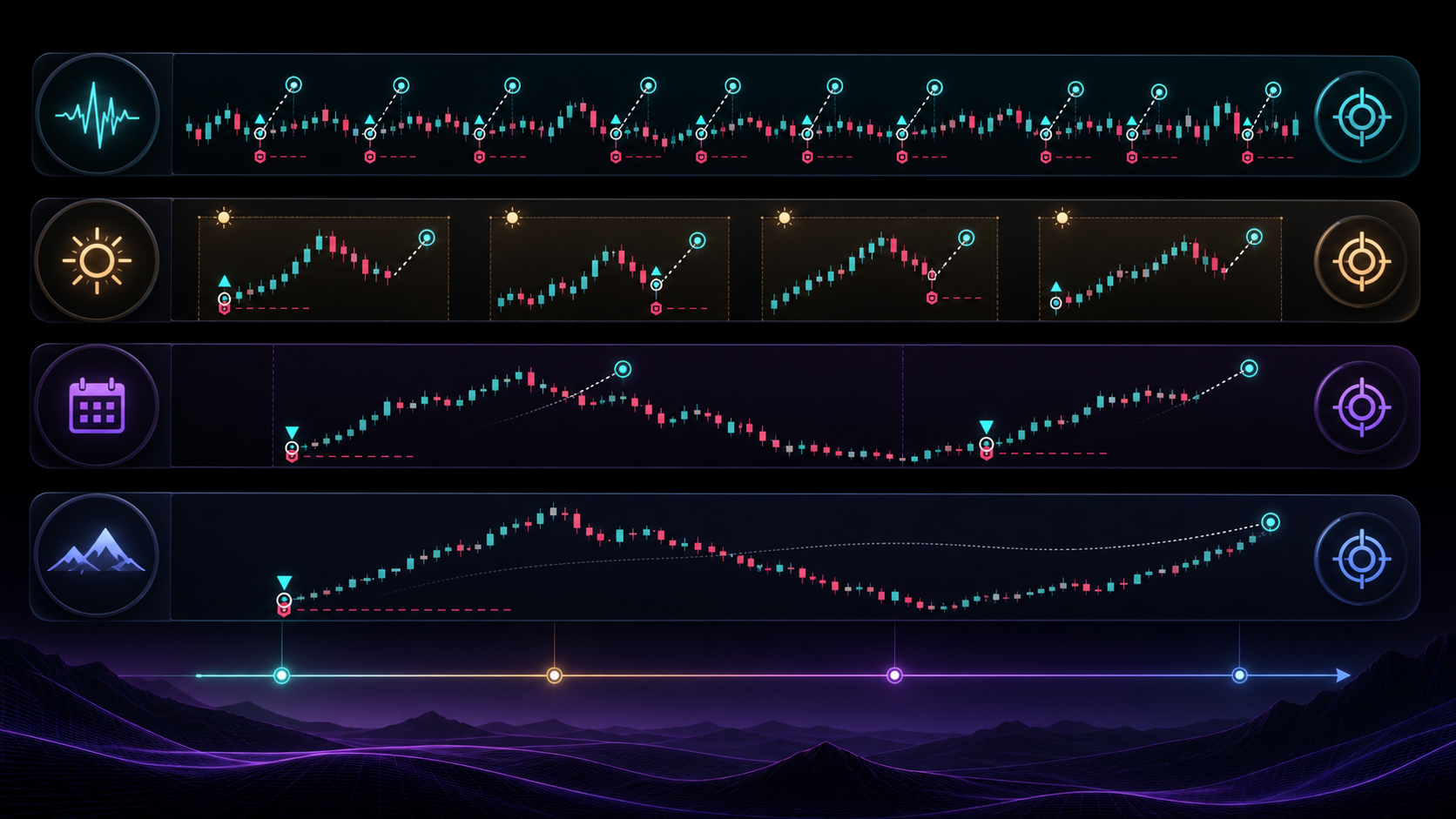
Choose a style that fits your available time, attention, patience, costs, and emotional tolerance. Test one style long enough to understand it before changing.
The Four Common Trading Styles
| Style | Typical holding period | Decision frequency | Main challenge |
|---|---|---|---|
| Scalping | Seconds to minutes | Very high | Speed, costs, and discipline |
| Day trading | Minutes to hours | Moderate to high | Intraday focus and avoiding overtrading |
| Swing trading | Days to weeks | Lower | Holding through overnight movement |
| Position trading | Weeks to months | Low | Patience and larger price swings |
These categories overlap. What matters is not the label but the rules you actually follow.
Scalping
Scalpers seek small, short-lived price movements and usually close quickly.
Scalping may fit you if:
- you can focus without interruption;
- you make decisions quickly without becoming impulsive;
- you understand execution costs;
- you can accept many small outcomes;
- you enjoy detailed lower-timeframe behavior.
Scalping magnifies the impact of spread, fees, slippage, and hesitation. A strategy that looks strong before costs may have no edge after them.
Lower timeframes provide more signals, but also more noise and more opportunities to make mistakes. Beginners often benefit from learning on slower charts first.
Day Trading
Day traders open and close positions within the same trading day or session.
Advantages may include:
- no planned overnight exposure;
- clear session-based routines;
- regular opportunities;
- faster feedback than swing trading.
Challenges include screen time, frequent decisions, and the temptation to keep trading after the valid opportunities are gone.
ZenAlgo Sessions helps day traders understand when Asia, Europe, and US activity develops.
Swing Trading
Swing traders seek larger market movements over days or weeks.
Swing trading may fit people who:
- cannot watch charts continuously;
- prefer fewer, more considered decisions;
- can hold through normal pullbacks;
- are comfortable with overnight and weekend risk;
- enjoy higher-timeframe structure.
Swing traders typically need wider invalidation levels than scalpers. Position size must adjust so wider stops do not create excessive account risk.
Position Trading
Position traders follow broad trends or macro themes over weeks or months.
This style requires patience and the ability to distinguish normal volatility from genuine thesis failure. It can overlap with active investing, but a position trade should still have a defined thesis and exit logic.
Broader context tools such as Crypto Trend and Dominator are more relevant here than very short-term entry signals.
Choose Based on Your Real Life
Use your normal schedule, not your ideal schedule.
| Constraint | What it suggests |
|---|---|
| Only brief focused sessions | Consider selective day trading or planned review windows |
| Cannot watch during work | Consider swing or position trading |
| Easily stressed by rapid decisions | Avoid scalping |
| Uncomfortable holding overnight | Explore day trading |
| Limited tolerance for fees | Prefer lower-frequency styles |
| Strong patience but limited screen time | Explore swing trading |
No style eliminates the need for risk management or emotional control.
Match Style to Market Condition
A trading style and a setup are not the same thing.
A swing trader can use trend-following or mean-reversion setups. A day trader can trade breakouts or ranges. However, some combinations are naturally easier:
- Strong trends favor trend-following approaches.
- Balanced ranges favor selective mean reversion.
- Expanding volatility favors breakout approaches.
- Thin, random conditions often favor waiting.
ZenAlgo systems organize tools around these environments. For example:
- Avenger supports calm trend context.
- Ranger maps intraday and weekly VWAP-based ranges.
- Waves helps study momentum and exhaustion.
Run a Personal Fit Test
Before committing to a style, test it in simulation.
For twenty planned examples, record:
- How much time preparation required.
- Whether entries occurred during your available hours.
- How often you felt rushed or bored.
- Whether costs materially affected results.
- Whether you could follow the exit plan.
- Whether the pace was sustainable.
Choose the style you can execute well, not the style that produced the largest isolated win.
Common Mistakes
Choosing Scalping Because It Looks Exciting
Fast charts can feel productive while encouraging impulsive decisions.
Using a Swing Stop With a Scalp Position Size
Holding period, invalidation distance, and position size must work together.
Changing Style Every Day
Each style requires different expectations and skills. Constant switching makes meaningful review impossible.
Trading Outside Your Planned Hours
Fatigue and distraction damage execution. A setup is not high quality if you cannot manage it.
Key Takeaways
- Trading style is mainly a choice about time horizon and decision frequency.
- Fit the style to your actual schedule and temperament.
- Faster styles increase noise, costs, and execution demands.
- Slower styles require patience and tolerance for larger swings.
- Test one style consistently before changing.
Continue Learning
- Build a clean TradingView technical analysis setup.
- Compare the best charting platforms for traders.
- Revisit how to choose a market.
Practice With ZenAlgo
Use the trial to test one trading style, not all of them at once. Choose a small watchlist, define your active hours, and record whether the workflow fits your real schedule.
This article is educational only. Every trading style can produce losses, and shorter holding periods do not automatically reduce risk.