How to Avoid Revenge Trading
Revenge trading is entering trades to repair emotional pain instead of following a strategy.
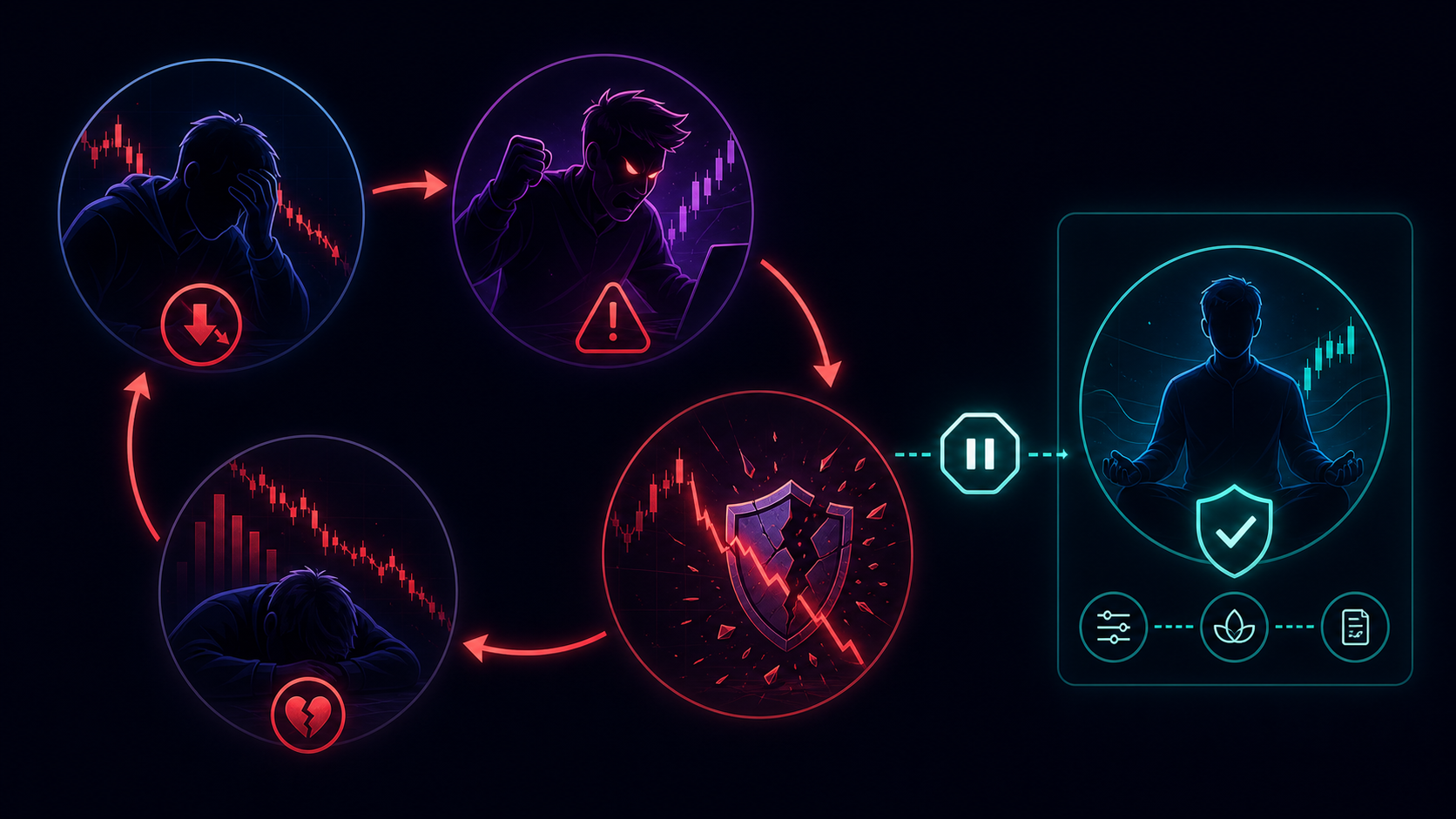
After a painful loss, your next job is not to make money back. Your next job is to protect decision quality.
Revenge trading often begins with a sentence that sounds rational:
"I just need one good trade to get back to even."
It does not feel like revenge at first. It feels like correction. The trader believes the loss was unfair, the stop was unlucky, or the market "should" still go in the original direction. They are not trying to be reckless. They are trying to remove the emotional discomfort of being down.
That discomfort is powerful. A red number can feel like an accusation. It can make the trader feel stupid, late, embarrassed, or trapped. The next trade becomes less about opportunity and more about self-defense.
This is why revenge trading is so dangerous: the trader thinks they are trading the market, but they are actually trading their own pain.
The Loop
The first loss hurts. The trader immediately looks for another entry. They increase size because a normal win would not recover the loss fast enough. They enter early because waiting feels unbearable. If price moves against them, they move the stop or add to the position because accepting another loss feels impossible.
Now the second trade is worse than the first. It has weaker logic, larger size, and more emotional pressure. If it loses, the trader is not only down money. They are also ashamed of breaking their own rules. That shame can trigger the next revenge trade.
This is how a normal losing trade turns into an account-damaging session.
The Immediate Reset
The cure is not a better entry signal in the next five minutes. The cure is interruption.
After a painful loss, stand up before you analyze. Leave the screen for 10 to 20 minutes. Do something physical and boring: water, air, walk, shower, food. You are not trying to solve the market. You are trying to return to a state where you can tell the truth.
When you come back, write one sentence: "Was this loss planned or unplanned?"
If the loss was planned, log it as the cost of doing business. If it was unplanned, stop trading and review later. An unplanned loss is evidence that the process is already damaged. Taking another trade from that state is rarely a professional decision.
Planned Loss vs Emotional Loss
A planned loss is uncomfortable, but it is not an emergency. It was defined before entry. It fits the risk model. It belongs in the sample.
An emotional loss is different. It often includes oversizing, moving stops, chasing, averaging down, or entering without invalidation. That kind of loss is not just financial. It is behavioral feedback. The response should be protection, not acceleration.
The trader who survives learns to treat these two losses differently. A planned loss gets logged. An emotional loss triggers a stop.
Using ZenAlgo
Use risk management first. Tools like Engine and Five Elements should only matter after you are calm enough to follow the checklist.
If you are using indicators to justify a trade you already emotionally decided to take, pause. That is not analysis. That is confirmation shopping.
Continue Learning
- Review why averaging down can destroy an account.
- Learn how to handle losing streaks.
- Study a good losing trade.
Revenge trading can cause rapid losses, especially with leverage. Stop trading immediately if you feel compelled to win money back.