How to Stop Overtrading
Overtrading is taking too many trades, taking trades outside the plan, or continuing after your decision quality has dropped.
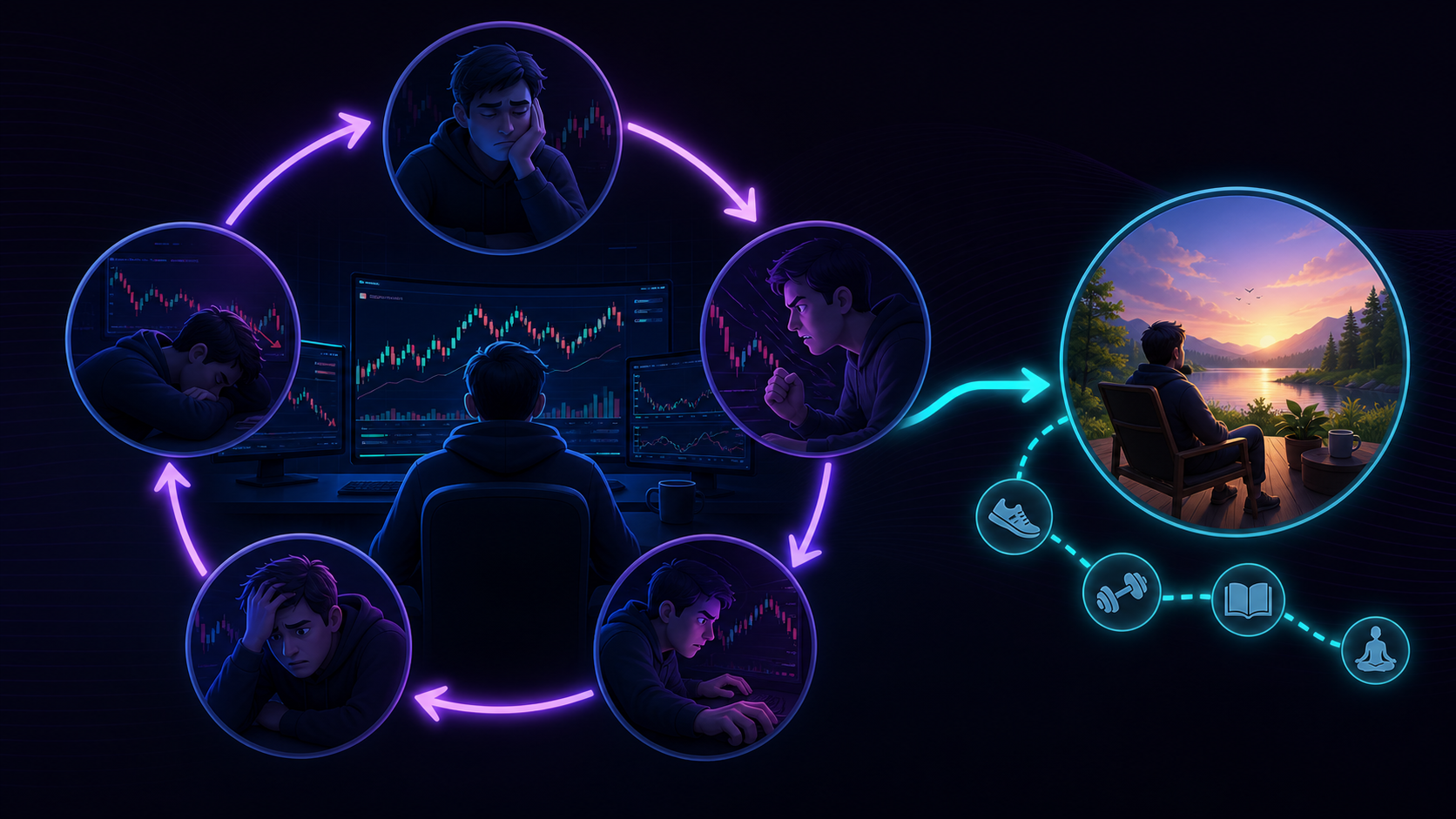
Overtrading is often an emotional regulation problem disguised as analysis. The fix is fewer decisions, clearer filters, and hard stop conditions.
Overtrading rarely begins with a dramatic mistake. More often, it begins with boredom.
You sit down with a plan. You know the setup you want. The market does nothing. Ten minutes pass. Then twenty. You refresh the chart, switch timeframes, draw another line, zoom in, zoom out, check another pair, then come back to the first one. Somewhere in that loop, the mind starts to feel that waiting is wasting time.
Then a small candle moves.
It is not your setup, not really. But after staring at the screen for long enough, almost anything can start to look meaningful. The brain wants action, so it upgrades weak evidence into a trade idea. You tell yourself you are being flexible. In reality, your strategy did not find the trade. Your restlessness did.
The Hidden Cost
The problem with overtrading is not only the extra loss. It is the damage to the quality of your sample.
If your planned strategy takes two clean trades and you add five emotional trades around them, your review becomes polluted. You no longer know whether the strategy is underperforming or whether you are mixing it with boredom, revenge, FOMO, and fatigue. The journal becomes harder to read because the trader has become inconsistent.
There is also a physical cost. Every trade consumes attention. Every open position keeps the nervous system engaged. After enough decisions, the trader who was patient in the morning becomes sloppy in the afternoon. They start accepting weaker setups not because the market improved, but because their standards degraded.
The "I Already Spent Time Here" Trap
A very common overtrading thought is: "I have been watching this chart for an hour, so I should get something out of it."
That is sunk-cost emotion. The market does not owe you a setup because you donated attention to it. Time spent watching is not a reason to trade. Sometimes the correct return on that hour is simply the information that conditions are not good enough.
That can feel unsatisfying, but it is professional. A no-trade session can be a clean session.
What to Do Instead
The best solution is to reduce the number of moments where you have to be strong.
Set a maximum number of trades for the session. Define the exact conditions that must be present before a trade is allowed. Use alerts instead of staring at every candle. Take a mandatory break after a loss, especially if you feel the urge to "make it back." If your daily limit is reached, close the platform or move into review mode only.
And yes, sometimes the correct technical adjustment is very low-tech: leave the screen. Walk outside. Eat something. Let your eyes stop hunting for candles. "Touch grass" sounds like a joke until you realize that many bad trades are taken by a tired nervous system pretending to do analysis.
Using ZenAlgo
Engine readiness filters can help reduce weak trades. If readiness is not present and the setup does not meet your checklist, the trade is not "early." It is not your trade.
ZenAlgo can help you define what counts as readiness, but the tool cannot enforce patience for you. That part belongs to your process.
A Practical Reset
When you notice yourself scanning too many charts, changing timeframes repeatedly, or feeling annoyed that nothing is happening, stop and ask: "Am I looking for my setup, or am I looking for action?"
If the honest answer is action, set alerts and step away. Your edge does not improve because you are bored.
Continue Learning
- Learn when not to trade.
- Study FOMO.
- Create a pre-trade checklist.
Overtrading increases costs, mistakes, and emotional risk. Stop trading if decision quality deteriorates.